
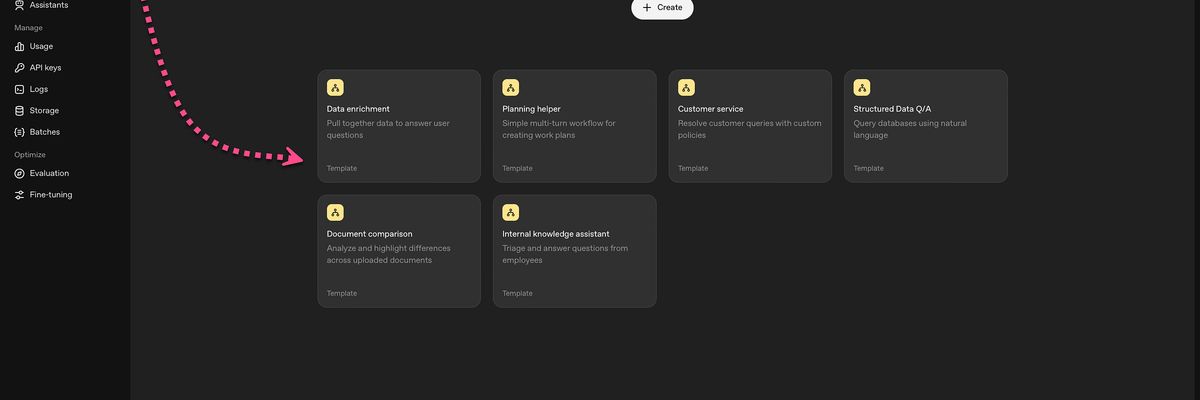
OpenAI Agent Builder

OpenAI Agent Builder is a visual platform for building, deploying, and managing autonomous AI agents. It provides a node-based workflow canvas, integrated tools, traceability, and safety controls that connect language models to real-world systems and data. By combining flexibility with guardrails, OpenAI Agent Builder helps teams create scalable, production-ready agentic applications for automation, product assistance, and enterprise operations.
OpenAI Agent Builder Details
Overview of OpenAI Agent Builder
What Is OpenAI Agent Builder
OpenAI Agent Builder is a platform tool designed to let developers and product teams visually build, configure, and deploy autonomous AI agents. Instead of starting from scratch, users can assemble agent workflows using modular nodes, connect them with tools and APIs, and version or control their logic. Agent Builder bridges the gap between natural language interfaces and real systems, making it easier to build agents that perform real tasks, interact with external systems, and execute multi-step operations autonomously.
With Agent Builder, OpenAI offers a unified canvas and orchestration framework that streamlines agent development while integrating safety, traceability, and modularity. The goal is to empower teams to build useful, reliable agentic experiences without reinventing orchestration plumbing.
How To Use OpenAI Agent Builder
Open the visual canvas
Start with the drag-and-drop node editor in Agent Builder to sketch your agent’s logic.
Define agent nodes and flows
Create nodes for decision points, API calls, tool invocations, and branching logic. Connect them to reflect the workflow.
Attach tools and connectors
Link nodes to built-in or custom tools such as web search, data retrieval, or API actions.
Set guardrails and logic constraints
Configure conditions, error handling, fallback paths, and controls to ensure safe operations.
Test and version
Simulate agent runs, inspect trace logs, and iterate on flows. Save version snapshots for rollback.
Deploy and monitor
Activate the agent in production, monitor its actions through built-in tracing, and refine based on logs and metrics.
OpenAI Agent Builder Key Features
- Visual Workflow Canvas: Design agent logic graphically using nodes and connections.
- Tool and Connector Integration: Add built-in tools or connect to external APIs and systems.
- Responses and Assistants API Support: Power agents with OpenAI’s latest APIs for reasoning and tool use.
- Traceability and Debugging: View detailed execution traces, decision logs, and tool call histories.
- Version Control and Rollback: Maintain multiple agent versions and revert when needed.
- Security and Guardrails: Configure constraints, fallback logic, and human oversight where necessary.
- Seamless Deployment: Launch agents with minimal infrastructure setup and full observability.
OpenAI Agent Builder Use Cases
- Automation Workflows: Automate support triage, data updates, or internal processes without manual intervention.
- Smart Assistants in Products: Embed agents in apps for recommendations, task execution, or context-aware actions.
- Data and Research Agents: Build agents that retrieve, analyze, and summarize information autonomously.
- Customer Workflows: Enable agents to interact with CRMs, ticketing systems, or booking platforms.
- Hybrid Human and AI Systems: Combine automated reasoning with human oversight for collaborative workflows.
OpenAI Agent Builder FAQ
Is OpenAI Agent Builder free or paid?
Agent Builder is part of OpenAI’s developer platform, with pricing determined by usage, model calls, and feature tiers.
Can I build multi-agent systems or only single agents?
Yes. You can orchestrate multi-node workflows that represent distinct roles, branching logic, and delegation between components.
Does it require coding skills?
The visual interface reduces coding requirements, but developers can extend or customize nodes with code if needed.
Which models or APIs does it support?
It integrates natively with OpenAI’s Responses and Assistants APIs, enabling built-in reasoning and tool orchestration.
Can agents interact with external systems?
Yes. Agents can call APIs, access databases, and perform actions across integrated systems.
How do I debug or monitor agent execution?
Agent Builder includes trace logs, node-level execution data, and performance monitoring to visualize agent behavior.
Explore More AI Agents
Discover other AI agents and tools to enhance your workflow and productivity.
Browse All AgentsRelated AI Agents
View All Agents →
Tale
Tale is an open-source project workspace for teams and AI agents. Teammates plan tasks on a shared board, assign work to people or agents, and review the results together, while agents run in persistent sandboxes using runtimes such as Claude Code and Codex. It combines task boards, shared knowledge, workflows, and governance controls, and can be self-hosted with Docker or run as managed Cloud. Tale is MIT licensed, and the free Community edition includes every feature.

VoiceDrop
VoiceDrop is a ringless voicemail and SMS platform built for sales teams. It clones a user’s voice from roughly a 30-second sample and delivers personalized voicemails to US mobile and VoIP numbers without ringing the phone, with two-way SMS in the same workflow. Billing applies only to successful deliveries, and the platform includes SOC 2 Type II compliance, Do Not Call suppression, phone validation, a REST API, and Zapier and Make integrations.

Arvow
Arvow is an AI SEO platform for marketers and agencies. Its agents help research, write, and publish content in a brand’s voice, identify technical SEO issues, and find relevant sites for contextual backlinks. Arvow also tracks brand mentions across AI search tools, bringing content, site optimization, link building, and AI visibility into one platform.
Trending AI Agents
View All Agents →
Site Speak
SiteSpeak AI lets you train a custom chatbot on your website content, FAQs, and documents. Site Speak AI can answer visitor questions instantly, 24/7, with no coding required.

Murf AI
Murf AI is a text-to-speech platform that transforms written content into lifelike voiceovers. It’s perfect for creators, educators, and businesses needing high quality narration without recording audio manually.
Synthesia
Synthesia is an AI video generation platform that lets users create professional-looking videos using realistic AI avatars. It enables anyone to turn text into engaging videos in minutes—no cameras, microphones, or actors required.
Tale
Tale is an open-source project workspace for teams and AI agents. Teammates plan tasks on a shared board, assign work to people or agents, and review the results together, while agents run in persistent sandboxes using runtimes such as Claude Code and Codex. It combines task boards, shared knowledge, workflows, and governance controls, and can be self-hosted with Docker or run as managed Cloud. Tale is MIT licensed, and the free Community edition includes every feature.
VoiceDrop
VoiceDrop is a ringless voicemail and SMS platform built for sales teams. It clones a user’s voice from roughly a 30-second sample and delivers personalized voicemails to US mobile and VoIP numbers without ringing the phone, with two-way SMS in the same workflow. Billing applies only to successful deliveries, and the platform includes SOC 2 Type II compliance, Do Not Call suppression, phone validation, a REST API, and Zapier and Make integrations.
Arvow
Arvow is an AI SEO platform for marketers and agencies. Its agents help research, write, and publish content in a brand’s voice, identify technical SEO issues, and find relevant sites for contextual backlinks. Arvow also tracks brand mentions across AI search tools, bringing content, site optimization, link building, and AI visibility into one platform.