ZBrain

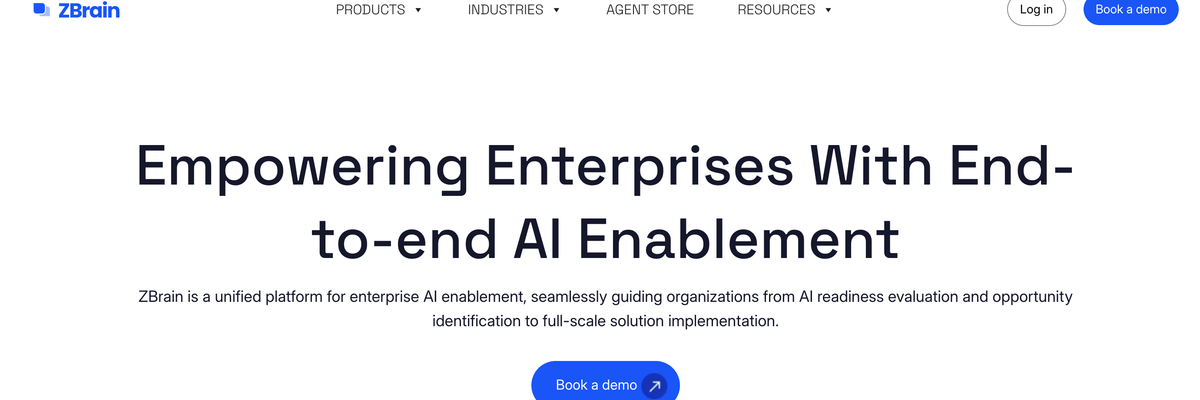
ZBrain is an enterprise-grade AI platform that helps organizations design, assess, and deploy AI solutions across every department. It combines strategic planning, readiness analysis, and low-code agent building into one unified ecosystem. Companies can automate workflows, connect proprietary data, and build custom AI applications while maintaining full security and governance. With multi-model support, enterprise integrations, and a scalable architecture, ZBrain is built for teams that want powerful AI automation without sacrificing control, compliance, or data privacy.
ZBrain Details
Overview of ZBrain
ZBrain is an enterprise agentic AI platform that helps organizations analyze AI opportunities, design solutions, build AI agents, connect business systems, and govern those solutions in production.
The platform provides a structured path for moving from an initial AI use case to a working solution with defined workflows, integrations, permissions, approvals, and operational controls. Businesses can use ZBrain to create new agentic AI solutions or manage agents that were built using other enterprise AI platforms and frameworks.
ZBrain is designed for organizations that need more than a basic AI chatbot or isolated automation tool. It gives teams a central environment for planning, building, deploying, monitoring, and governing AI agents across multiple departments.
ZBrain Details
Pricing: Paid
Category: Agent Tools
Primary Use: Enterprise AI agent development and governance
Best For: Large organizations, operations teams, AI leaders, compliance teams, developers, and enterprise technology departments
Deployment: Enterprise cloud environments
Access: Demo or guided trial may be required
Reviewed by Add AI Directory Editorial Team
The Add AI Directory Editorial Team reviewed ZBrain based on publicly available product information, official platform documentation, stated capabilities, supported use cases, and enterprise deployment features.
ZBrain is positioned as an enterprise platform for organizations that want to move AI projects from planning into controlled production environments. Its strongest differentiator is the combination of AI use case analysis, technical solution design, agent building, workflow orchestration, and runtime governance.
The platform may be most relevant to organizations with complex data environments, multiple business systems, strict access requirements, or formal compliance processes. Smaller teams searching for a simple chatbot builder may find ZBrain more extensive than necessary.
Product features, integrations, pricing, and availability may change. Businesses should confirm current capabilities and requirements directly with ZBrain before selecting the platform.
Sources
Official ZBrain website
Official ZBrain product pages
Official ZBrain documentation
Publicly available security, governance, and platform information
Ready to try ZBrain?
Visit ZBrain to explore its enterprise agentic AI platform, request a demonstration, and learn how it can support AI development and governance across your organization.
Overview of ZBrain
ZBrain is an enterprise agentic AI orchestration platform created to help organizations build and operate AI solutions within a governed environment. It brings together AI use case analysis, technical design, agent development, workflow automation, data integration, deployment controls, and ongoing governance.
Many organizations can identify possible uses for artificial intelligence but struggle to convert those ideas into reliable production systems. A proposed AI project may lack clearly defined business requirements, approved data sources, security controls, integration plans, ownership, or measurable outcomes.
ZBrain addresses this problem by giving teams a structured process for developing AI solutions. Organizations can begin with a business need, collect the required context, document the technical requirements, configure the necessary agents and workflows, and deploy the final solution with governance controls already included.
The platform can also serve as a centralized governance layer for agents created through external platforms and frameworks. This allows an organization to register agents, document their purpose, define which tools and data they may access, apply policies, track approvals, and review agent activity.
ZBrain is intended for enterprise environments where AI agents may interact with sensitive information, internal applications, customer data, financial systems, operational workflows, or regulated processes. Its governance features help businesses define how agents should behave before those agents are allowed to perform important actions.
Instead of treating governance as a final review, ZBrain incorporates permissions, policies, approvals, auditability, and operational controls throughout the AI development lifecycle.
What Is ZBrain
ZBrain is a platform for creating and governing agentic AI solutions. Agentic AI refers to systems that can interpret goals, access information, use tools, make decisions within defined boundaries, and complete connected tasks.
A basic AI assistant may answer a question or generate text. An AI agent can go further by retrieving business data, analyzing documents, calling an application, updating a record, requesting approval, generating a report, or continuing through a multistep workflow.
ZBrain gives organizations the tools to design these workflows while maintaining control over what each agent can access and what actions it can perform.
The platform supports the full development process.
Organizations can first analyze an AI use case and gather information from the employees or departments involved. This helps define the problem, expected outcome, business owner, required systems, available data, possible risks, and operational dependencies.
Teams can then create a technical design that documents the proposed architecture, user journeys, workflow logic, integrations, data requirements, agent responsibilities, approval steps, and governance considerations.
Once the design is approved, the organization can build the solution by configuring agents, connecting systems, adding tools, defining workflows, setting guardrails, and creating the user interface.
The completed solution can then be deployed within the organization’s preferred cloud environment and managed through a central governance framework.
ZBrain can be used to build AI solutions for finance, human resources, legal operations, customer support, procurement, sales, marketing, manufacturing, logistics, healthcare, retail, real estate, hospitality, and other business functions.
The platform may also help organizations manage AI agents created with services such as Azure AI Foundry, AWS Bedrock, Google Vertex AI, LangGraph, Google Agent Development Kit, Microsoft Semantic Kernel, and other supported frameworks.
This broader compatibility can help businesses govern an existing collection of AI agents without rebuilding every solution inside a single development environment.
How To Use ZBrain
1. Identify an AI use case
Begin with a specific business problem or workflow that could benefit from AI.
The use case might involve reviewing documents, answering employee questions, monitoring regulations, researching companies, assisting customers, processing requests, generating reports, or coordinating information across several applications.
A clearly defined use case gives the project a measurable purpose and prevents the organization from building an AI solution without a practical business outcome.
2. Collect business requirements
Gather information from the employees, managers, subject matter experts, and technology teams connected to the process.
Document how the current workflow operates, which systems are involved, what information is required, where delays occur, and what a successful result should look like.
This stage should also identify the people responsible for the use case and the departments that will approve or manage the completed solution.
3. Analyze the use case
Use ZBrain to organize the collected information and evaluate the proposed solution.
The analysis can capture the business context, process requirements, system dependencies, data sources, ownership, expected value, and potential risks.
This gives technical teams a more complete foundation before development begins.
4. Create the technical design
Translate the approved use case into a build ready technical plan.
The design can include business requirements, functional requirements, agent responsibilities, workflow steps, user journeys, application architecture, integrations, data requirements, approval processes, security controls, and governance rules.
Stakeholders can review and refine the design before the project moves into development.
5. Select models and tools
Choose the AI models, business applications, tools, databases, and services required by the solution.
Different agents may use different models depending on the task. An organization may select one model for document analysis, another for conversational support, and another for reasoning or structured data extraction.
The selected tools should match the organization’s performance, privacy, security, and cost requirements.
6. Connect business data
Connect the documents, databases, cloud storage systems, application programming interfaces, knowledge bases, and internal platforms the agents need to access.
The quality of an AI agent often depends on the quality and relevance of the information available to it. Organizations should define which sources are approved and which types of data each agent is allowed to retrieve.
7. Build the agentic solution
Use ZBrain Solution Builder to configure the agents, tools, workflows, integrations, user interface, and approval points.
Teams can define the purpose of each agent and determine how multiple agents should cooperate. One agent may collect information, another may analyze it, and another may prepare the final output for human review.
Developers and business teams can test the workflow, review agent responses, adjust instructions, and improve the solution before deployment.
8. Add governance controls
Define the policies and controls that govern how the solution operates.
These controls may include approved models, permitted tools, data access boundaries, confidence requirements, human approval steps, cost limits, security rules, escalation procedures, and activity logging.
Governance controls help prevent agents from taking actions outside their approved purpose.
9. Test the solution
Test the agents with realistic business scenarios before making the solution available to employees or customers.
Review response accuracy, workflow completion, data access, tool usage, exception handling, approval requests, and failure conditions.
Testing should also confirm that sensitive actions cannot be completed without the required authorization.
10. Deploy the solution
Deploy the completed solution within the organization’s preferred cloud environment, security perimeter, region, and technology infrastructure.
The organization can maintain control over its selected models, credentials, data sources, endpoints, and connected systems.
11. Monitor agent activity
Track how agents use data, tools, workflows, and approvals after deployment.
Teams can review policy decisions, exceptions, escalations, agent actions, tool activity, and completed workflows through a centralized governance view.
Monitoring helps organizations identify inaccurate outputs, inefficient workflows, policy violations, unexpected costs, and opportunities for improvement.
12. Expand successful solutions
Once a solution performs reliably, the organization can extend it to additional teams, locations, workflows, or business functions.
The existing governance framework can help maintain consistent controls as AI adoption grows across the organization.
ZBrain Key Features
Enterprise AI Governance
ZBrain provides a governance framework for managing agentic AI across enterprise, departmental, and application levels.
Organizations can define common policies for identity, access, data usage, approved models, security requirements, auditing, cost controls, and tool permissions.
Runtime Controls
ZBrain can apply policies while an agent is performing a task, rather than relying only on reviews completed before deployment.
Runtime controls can help manage confidence requirements, approval gates, permitted actions, exceptions, and critical workflow steps.
Central Agent Registry
Organizations can register agents and document their purpose, owner, identity, approved tools, authorized data sources, access level, autonomy, and current lifecycle status.
This gives business and technology leaders a clearer view of the agents operating across the organization.
Agent Activity Auditing
ZBrain records agent actions, policy decisions, approvals, exceptions, and tool usage.
These records can help organizations investigate incidents, demonstrate compliance, review performance, and understand how important decisions were made.
Human Approval Workflows
Teams can require human review before an agent completes a sensitive or high impact action.
Approval steps may be added to financial processes, legal workflows, account changes, purchasing decisions, data updates, and other controlled activities.
Emergency Agent Controls
Application level controls can allow authorized teams to stop an agent or solution when unexpected behavior occurs.
This capability can reduce operational risk when an agent produces inaccurate results, accesses the wrong information, or behaves outside its intended purpose.
AI Use Case Analysis
ZBrain helps organizations collect and structure the information needed to evaluate an AI opportunity.
Teams can document the business problem, workflow, ownership, systems, data, expected value, risks, and implementation requirements.
Technical Design Generation
ZBrain Design helps convert an analyzed use case into detailed technical documentation.
The resulting design may include business requirements, functional requirements, user journeys, architecture, workflow logic, integration details, data requirements, and governance considerations.
Conversational Solution Building
ZBrain Solution Builder provides a conversational environment for turning an approved technical design into a working agentic solution.
Teams can create agents, configure workflows, connect systems, define approval points, add controls, and generate an interface for the completed application.
AI Agent Orchestration
ZBrain supports workflows involving multiple specialized agents.
Each agent can be assigned a specific responsibility, such as retrieving information, analyzing data, checking compliance requirements, generating an output, or requesting human approval.
Enterprise Data Integration
The platform can connect AI solutions with internal documents, databases, knowledge systems, cloud environments, business applications, and external services.
These integrations allow agents to work with organization specific information rather than relying only on general model knowledge.
Multiple Model Support
Organizations can use different AI models and providers based on their technical, operational, security, and performance requirements.
This flexibility can reduce dependence on a single model provider and allow teams to select the most suitable model for each task.
External Agent Governance
ZBrain can govern agents created on supported external AI platforms and frameworks.
This allows organizations to introduce centralized policies and auditing without requiring every existing agent to be completely rebuilt.
Controlled Enterprise Deployment
ZBrain can operate within the client’s preferred cloud environment, tenant, region, and security perimeter.
This can help organizations maintain control over credentials, models, data, infrastructure, and connected systems.
Department Specific Governance
Different business functions can apply controls suited to their responsibilities.
Finance, legal, human resources, operations, and other departments may use different data sources, approval chains, tools, and risk policies.
Customer Support Automation
Organizations can build agents that answer common questions, retrieve account information, summarize support cases, classify requests, and assist human support representatives.
Complex or sensitive cases can be escalated to the appropriate employee.
Regulatory Monitoring
ZBrain can support solutions that monitor regulatory information, identify relevant changes, summarize new requirements, and notify compliance teams.
Human reviewers can verify the information before operational or legal decisions are made.
Sales Assistance
Sales agents can research accounts, summarize opportunities, identify missing information, suggest next actions, and help representatives prepare for meetings.
These tools can reduce manual research while keeping sales professionals involved in important decisions.
Due Diligence Research
Organizations can build research agents that gather information from approved sources, review documents, extract important details, compare findings, and prepare structured reports.
This may support investment research, vendor reviews, mergers, acquisitions, partnerships, and other due diligence processes.
Procurement and Operations
AI agents can assist with vendor analysis, purchase requests, approval routing, logistics information, document processing, and operational reporting.
Governance controls can ensure that important purchasing or system actions still require authorization.
Internal Employee Assistance
Organizations can create internal assistants that answer questions about company policies, procedures, benefits, technology systems, onboarding, and workplace resources.
The agent can retrieve information from approved internal documents and direct employees to human support when needed.
Scalable AI Management
ZBrain gives organizations a framework for managing more agents, workflows, departments, and use cases as enterprise AI adoption expands.
This can help prevent disconnected AI projects from operating without shared standards, ownership, or oversight.
Ready to try ZBrain?
Visit ZBrain to request a demonstration, discuss your enterprise AI requirements, and explore how the platform can help your organization analyze, build, deploy, and govern agentic AI solutions.
Explore More AI Agents
Discover additional AI agents and platforms for automation, software development, customer service, research, productivity, marketing, operations, and enterprise workflow management.
Browse the Add AI Directory to compare tools by category, pricing model, primary use case, and platform capabilities.
Similar to ZBrain
Explore AI agent builders, enterprise automation platforms, development agents, workflow orchestration tools, and governance solutions with capabilities similar to ZBrain.
Compare each platform based on its supported models, integrations, deployment options, data controls, security features, development requirements, and intended users.
Trending AI Agents
Browse AI agents currently receiving attention across business automation, software development, customer communication, productivity, research, content creation, and other growing AI categories.
Review each listing to understand what the agent does, who it is designed for, how it is used, and whether free or paid access is available.
Explore More AI Agents
Discover other AI agents and tools to enhance your workflow and productivity.
Browse All AgentsRelated AI Agents
View All Agents →
Tale
Tale is an open-source project workspace for teams and AI agents. Teammates plan tasks on a shared board, assign work to people or agents, and review the results together, while agents run in persistent sandboxes using runtimes such as Claude Code and Codex. It combines task boards, shared knowledge, workflows, and governance controls, and can be self-hosted with Docker or run as managed Cloud. Tale is MIT licensed, and the free Community edition includes every feature.

VoiceDrop
VoiceDrop is a ringless voicemail and SMS platform built for sales teams. It clones a user’s voice from roughly a 30-second sample and delivers personalized voicemails to US mobile and VoIP numbers without ringing the phone, with two-way SMS in the same workflow. Billing applies only to successful deliveries, and the platform includes SOC 2 Type II compliance, Do Not Call suppression, phone validation, a REST API, and Zapier and Make integrations.

Arvow
Arvow is an AI SEO platform for marketers and agencies. Its agents help research, write, and publish content in a brand’s voice, identify technical SEO issues, and find relevant sites for contextual backlinks. Arvow also tracks brand mentions across AI search tools, bringing content, site optimization, link building, and AI visibility into one platform.
Trending AI Agents
View All Agents →
Site Speak
SiteSpeak AI lets you train a custom chatbot on your website content, FAQs, and documents. Site Speak AI can answer visitor questions instantly, 24/7, with no coding required.

Murf AI
Murf AI is a text-to-speech platform that transforms written content into lifelike voiceovers. It’s perfect for creators, educators, and businesses needing high quality narration without recording audio manually.
Synthesia
Synthesia is an AI video generation platform that lets users create professional-looking videos using realistic AI avatars. It enables anyone to turn text into engaging videos in minutes—no cameras, microphones, or actors required.
Tale
Tale is an open-source project workspace for teams and AI agents. Teammates plan tasks on a shared board, assign work to people or agents, and review the results together, while agents run in persistent sandboxes using runtimes such as Claude Code and Codex. It combines task boards, shared knowledge, workflows, and governance controls, and can be self-hosted with Docker or run as managed Cloud. Tale is MIT licensed, and the free Community edition includes every feature.
VoiceDrop
VoiceDrop is a ringless voicemail and SMS platform built for sales teams. It clones a user’s voice from roughly a 30-second sample and delivers personalized voicemails to US mobile and VoIP numbers without ringing the phone, with two-way SMS in the same workflow. Billing applies only to successful deliveries, and the platform includes SOC 2 Type II compliance, Do Not Call suppression, phone validation, a REST API, and Zapier and Make integrations.
Arvow
Arvow is an AI SEO platform for marketers and agencies. Its agents help research, write, and publish content in a brand’s voice, identify technical SEO issues, and find relevant sites for contextual backlinks. Arvow also tracks brand mentions across AI search tools, bringing content, site optimization, link building, and AI visibility into one platform.