AG2

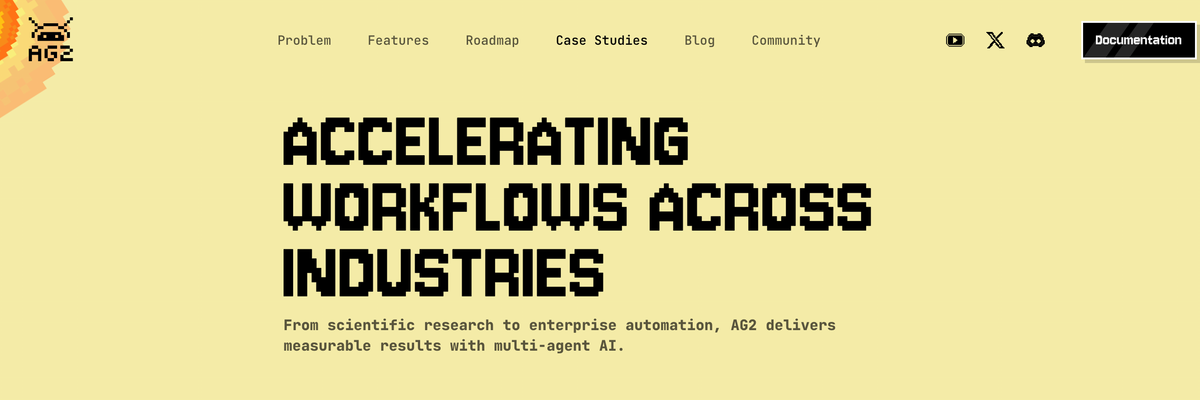
AG2 is an open-source agent framework (AgentOS) for building and orchestrating multi-agent AI systems. It lets developers define specialized agents, coordinate their interactions, integrate tools and human oversight, and deploy complex workflows. AG2 abstracts away routing, state management, and conversation patterns so you can focus on designing intelligent agent teams.
AG2 Details
Overview of AG2
AG2 is an open source AgentOS and programming framework for building, coordinating, and evaluating intelligent AI agents. Developers can use AG2 to create individual agents, connect specialized agents into collaborative networks, give them access to tools and data, and maintain human control at important points in a workflow.
The framework provides reusable components for model configuration, agent communication, tool execution, structured responses, memory, middleware, testing, and multi agent orchestration. This allows development teams to focus on the behavior and purpose of their agents instead of building every part of the underlying agent infrastructure from the beginning.
Overview of AG2
AG2 helps developers build AI systems that can reason, communicate, use tools, and work together to complete complex tasks. It can support a simple conversational assistant, a tool using automation agent, or a coordinated network of agents with different responsibilities.
Each agent can be assigned a specific role, such as researcher, planner, reviewer, coder, data analyst, or supervisor. These agents can exchange information, review one another’s work, call external functions, and pass tasks between different parts of a workflow.
AG2 also supports human involvement when a task requires approval, clarification, or professional judgment. Developers can define when an agent should proceed automatically and when it should pause for input from a person.
Because AG2 is open source and designed for extensibility, developers can customize its components, connect different model providers, add their own tools, and design workflows that fit specific applications. It can be used for experimentation, internal automation, research projects, developer tools, and production AI systems.
What Is AG2
AG2, formerly associated with the AutoGen project, is an open source framework for developing agentic AI applications. It provides the core infrastructure needed to create agents and coordinate how they interact with models, tools, humans, and other agents.
An AG2 agent can receive a request, process information through a connected language model, use available tools, and return a response. The agent can also maintain conversation history so that later interactions retain relevant context.
Developers can create multiple agents with separate instructions and capabilities. For example, one agent may collect information, another may analyze it, and a third may review the result before it is returned. A supervisor agent can also be added to decide which specialist should handle each part of the task.
AG2 includes built in orchestration patterns for controlling these interactions. Agents can work sequentially, participate in group conversations, operate under a supervisor, communicate through a shared network, or follow custom routing logic created by the developer.
The framework is model flexible. Teams can configure agents to use supported language model providers and select different models for different responsibilities. A complex reasoning agent may use one model while a classification or formatting agent uses another.
AG2 also allows agents to interact with software beyond the language model. Tools can connect agents with APIs, databases, files, internal services, search systems, calculation functions, and other applications. This makes it possible to build agents that take useful actions rather than only generate text.
How To Use AG2
Install AG2
Begin by installing AG2 in a Python environment. Developers can install the core framework and add optional packages based on the language models and capabilities required by the project.
AG2 requires a supported Python version and can be installed through the Python package manager. It is helpful to create a separate virtual environment so project dependencies remain isolated and easier to manage.
Configure a Language Model
Connect AG2 to the language model that will provide reasoning and response generation for the agents. Add the necessary provider configuration, model name, authentication credentials, and generation settings.
Credentials should be stored securely in environment variables or protected configuration files. They should not be written directly into source code or committed to a public repository.
Different agents can use different model configurations. Developers can select a more capable model for complicated reasoning and a faster model for simpler tasks such as classification, routing, or formatting.
Create an Agent
Create an agent and give it a clear name, purpose, and set of instructions. These instructions determine how the agent should behave, what responsibilities it has, and what type of output it should produce.
A well defined agent should have a focused role. For example, a research agent may gather relevant information, while a review agent checks factual consistency and identifies missing details.
The agent can then receive a message, process the request, and produce a response using its configured language model.
Add Tools
Register Python functions or external services as tools that the agent can use. Tools allow agents to retrieve data, perform calculations, access business systems, read files, search databases, or trigger actions.
Each tool should have a clear purpose and predictable input requirements. Developers should also control which agents can access each tool so that agents only receive the permissions they need.
For sensitive actions, the workflow can require human approval before a tool is executed.
Build a Multi Agent Workflow
Create additional agents when a task benefits from separate areas of expertise. Assign each agent a defined responsibility and determine how information should move between them.
A research workflow might include a researcher, an analyst, a writer, and a reviewer. A software development workflow might include a planner, coder, test agent, and security reviewer.
AG2 can coordinate these agents through sequential conversations, shared networks, supervisor patterns, group discussions, or custom interaction rules.
Add Human Oversight
Configure human involvement for decisions that should not be completely automated. An agent can pause and request confirmation, additional information, or approval before continuing.
Human oversight is useful when an agent is preparing a sensitive action, modifying important information, accessing protected systems, or making a decision that requires professional judgment.
Feedback from the user can be added to the ongoing conversation so the agents can adjust their next actions.
Define Structured Outputs
Use structured output models when an application requires responses in a specific format. Developers can define required fields, expected data types, and validation rules.
Structured outputs are helpful when agent results will be stored in a database, displayed in an application, sent to another service, or used by a later step in an automation.
Instead of returning an unpredictable block of text, the agent can produce organized information that is easier for software systems to process.
Test and Evaluate the Agents
Run the workflow with different prompts, data conditions, and tool responses. Review whether each agent follows its role and whether the overall system produces reliable results.
AG2 supports evaluation and testing processes that can help teams compare agent configurations, measure performance, and detect regressions when models or instructions change.
Teams should test successful requests as well as incomplete information, tool failures, unexpected inputs, and situations that require human intervention.
Deploy and Monitor the Workflow
After testing, connect the AG2 application to the environment where it will be used. This may be an internal service, customer facing application, research system, automation platform, or developer tool.
Monitor agent conversations, tool calls, errors, response quality, latency, and usage. Observability helps developers understand how the system behaves and identify parts of the workflow that require improvement.
Agent instructions, tools, model configurations, and routing patterns can be adjusted as the application receives real world usage.
AG2 Key Features
Multi Agent Orchestration
AG2 allows developers to coordinate multiple agents inside one application. Each agent can have its own role, instructions, tools, model configuration, and access permissions.
Agents can collaborate through sequential tasks, supervised networks, group conversations, and custom communication patterns. This makes it possible to break a complicated objective into smaller responsibilities handled by specialized agents.
Flexible Conversation Patterns
Developers can control how agents communicate and determine which agent should act next. A workflow can follow a fixed sequence, rotate between agents, allow a supervisor to select the next participant, or use custom routing conditions.
These patterns provide more control than placing every instruction into a single large prompt.
Human In The Loop Workflows
AG2 supports workflows where agents can request input or approval from a person. Human involvement can be added at specific decision points rather than requiring constant supervision.
This helps teams automate routine steps while retaining control over sensitive, uncertain, or high impact actions.
Tool and Function Integration
Agents can use registered tools to interact with external systems. A tool may retrieve information, execute a calculation, update a record, access a file, call an API, or perform another defined operation.
Tool access turns an agent from a conversational interface into a component that can participate in real business and technical workflows.
Multiple Model Support
AG2 can be configured to work with different language models and providers. Developers can choose models according to reasoning quality, speed, cost, context capacity, or application requirements.
Different agents in the same workflow can use different models. This allows teams to reserve more advanced models for demanding tasks while using efficient models for routine steps.
Structured Outputs
Agents can return responses that follow predefined schemas. Structured outputs improve consistency and make agent results easier to validate, store, display, and pass into other software.
This feature is useful for extraction, classification, reporting, form completion, API responses, and automated decision systems.
Agent Memory and Knowledge
AG2 provides components for retaining useful context and supplying agents with relevant knowledge. Persistent knowledge can help agents work with application specific information instead of relying only on the current message.
Context assembly and conversation history management can also help control what information is supplied to a model during each turn.
Middleware and Custom Behavior
Developers can add middleware and other customization layers around agent activity. These components can support validation, access control, logging, transformations, safety checks, and organization specific business rules.
The framework can therefore be adapted to different technical environments without forcing every project to use the same agent behavior.
Evaluation and Testing
AG2 includes capabilities for evaluating agent performance and comparing different configurations. Teams can test prompts, models, tools, and orchestration strategies before introducing changes into production.
Regression testing helps identify when an update causes an agent to become less accurate, less reliable, or less consistent.
Observability and Telemetry
Developers can observe how agents process tasks, communicate, and call tools. Logs and telemetry can help teams investigate failures, identify slow steps, and understand how an output was produced.
This is especially important for multi agent systems because a final response may depend on several interactions between models and tools.
Open Source Architecture
AG2 is available as an open source project, allowing developers to inspect the code, contribute improvements, and adapt the framework to their own applications.
Its open architecture can be useful for organizations that want more control over their agent infrastructure and do not want to depend entirely on a closed development platform.
AG2 Use Cases
AI Research Systems
Researchers can build groups of agents that collect information, compare findings, critique assumptions, and help organize complex research tasks.
Separate agents can be assigned to literature review, data interpretation, hypothesis generation, methodology review, and final validation.
Software Development Agents
Development teams can create agents for planning features, generating code, reviewing changes, creating tests, debugging errors, and documenting software.
A multi agent workflow allows each stage to be handled by a focused agent instead of asking one general agent to complete the entire development process.
Data Analysis Workflows
AG2 can support agents that retrieve data, run calculations, execute code, identify patterns, and explain results.
One agent may prepare the data, another performs the analysis, and a review agent checks whether the conclusions are supported by the available information.
Customer Support Automation
Businesses can build support systems that classify customer requests, retrieve account information, search knowledge bases, draft responses, and escalate difficult issues.
Different support agents can specialize in billing, technical problems, account access, product information, or customer retention.
Business Process Automation
Organizations can use AG2 to coordinate workflows that involve documents, databases, internal APIs, approvals, and repeated decisions.
Agents can collect information, validate inputs, prepare recommendations, and route tasks to employees when human judgment is required.
Content Research and Production
A content workflow can include agents for topic research, outlining, drafting, fact checking, editing, and formatting.
Assigning these responsibilities to separate agents can create a more controlled production process and make it easier to review how the final content was developed.
Knowledge Assistants
Companies can connect AG2 agents with internal documentation, databases, policies, and other knowledge sources.
Employees can then ask questions, retrieve relevant information, compare documents, and complete tasks using a conversational interface connected to approved company resources.
Workflow Supervisors
A supervisor agent can examine an incoming request and determine which specialist agent or tool should handle it.
This approach is useful when an application supports several types of requests and needs intelligent routing rather than a fixed sequence for every task.
Compliance and Review Processes
Organizations can create workflows where one agent completes a task and another checks it against predefined requirements.
Human approval can be required before the workflow performs a sensitive action or accepts a final result.
Scientific and Technical Collaboration
AG2 can support technical projects that require planning, code execution, calculations, analysis, and review.
Multiple agents can collaborate across these responsibilities while maintaining a record of the information exchanged throughout the process.
AG2 FAQ
Is AG2 Free To Use?
AG2 is an open source framework that developers can install and use without purchasing a platform subscription. However, users may still have expenses related to language model APIs, cloud infrastructure, databases, monitoring services, and other external tools connected to their application.
Is AG2 the Same as AutoGen?
AG2 developed from the AutoGen ecosystem and was previously known as AutoGen in earlier versions of the project. The current AG2 project uses updated packages, documentation, and architecture. Developers working with older AutoGen examples should check whether the code applies to AG2 or AG2 Classic before using it.
What Programming Language Does AG2 Use?
AG2 is primarily designed for Python developers. Agents, tools, model configurations, orchestration patterns, and application logic are generally defined through Python code.
What Is an AgentOS?
AgentOS describes the infrastructure used to create and operate agent based applications. In AG2, this includes components for agent communication, model access, tools, knowledge, memory, orchestration, human input, structured outputs, evaluation, and monitoring.
Can AG2 Build a Single AI Agent?
Yes. AG2 can be used to create a single agent with a model, instructions, tools, and conversation history. Developers do not need to create a multi agent system for every application.
Additional agents can be introduced later when the workflow requires separate expertise, review stages, or routing behavior.
Can AG2 Create Multi Agent Systems?
Yes. Multi agent coordination is one of AG2’s main capabilities. Developers can create specialized agents and control how they exchange messages, share context, call tools, and complete different parts of a task.
Can AG2 Connect to External Tools?
Yes. Developers can register functions and integrations that allow agents to work with APIs, files, databases, software services, calculations, and other external systems.
Tool permissions and approval requirements should be configured according to the sensitivity of each action.
Does AG2 Support Human Approval?
Yes. Human input can be added at selected points in an agent workflow. An agent can pause to request approval, clarification, missing information, or feedback before continuing.
Can AG2 Return Structured Data?
Yes. Developers can define structured output requirements so agent responses follow a consistent schema. This is useful when results need to be validated or consumed by another application.
Can Different Agents Use Different Models?
Yes. Each agent can be configured according to its responsibilities. Developers may use different models for reasoning, extraction, classification, review, or other specialized tasks.
Is AG2 Suitable for Production Applications?
AG2 includes capabilities that can support production agent systems, including tools, orchestration, structured outputs, middleware, telemetry, evaluation, testing, and human oversight.
Production readiness still depends on how the application is designed, secured, tested, monitored, and maintained by the development team.
Does AG2 Include Memory?
AG2 supports conversation history, persistent knowledge, context assembly, and related memory capabilities. Developers can determine what information should be retained and how it should be supplied to agents during future interactions.
How Is AG2 Different From a Basic Chatbot?
A basic chatbot typically receives a message and generates a text response. AG2 can coordinate several specialized agents, call tools, access external information, return structured data, request human approval, and manage longer workflows.
This allows developers to build systems that perform actions and collaborate across multiple stages instead of only answering questions.
Who Is AG2 Best For?
AG2 is best suited for developers, researchers, AI engineers, software teams, and organizations that want to build customizable agent applications in Python.
It is particularly useful when a project requires multiple agents, tool use, human oversight, structured outputs, flexible model selection, or control over the underlying agent architecture.
Explore More AI Agents
Discover other AI agents and tools to enhance your workflow and productivity.
Browse All AgentsRelated AI Agents
View All Agents →
Placement API
Placement API is an API and hosted MCP server that lets AI agents and SEO tools research and buy backlink placements. Agents can search publishers from 10 suppliers, compare supplier prices for the same domain, and turn a brief into a priced link plan with suspect domains filtered out. Read-only keys handle research, while purchases need a separate order key, prepaid credits, and server-enforced spending caps. Searching the catalogue and signing up are free.

Tale
Tale is an open-source project workspace for teams and AI agents. Teammates plan tasks on a shared board, assign work to people or agents, and review the results together, while agents run in persistent sandboxes using runtimes such as Claude Code and Codex. It combines task boards, shared knowledge, workflows, and governance controls, and can be self-hosted with Docker or run as managed Cloud. Tale is MIT licensed, and the free Community edition includes every feature.

VoiceDrop
VoiceDrop is a ringless voicemail and SMS platform built for sales teams. It clones a user’s voice from roughly a 30-second sample and delivers personalized voicemails to US mobile and VoIP numbers without ringing the phone, with two-way SMS in the same workflow. Billing applies only to successful deliveries, and the platform includes SOC 2 Type II compliance, Do Not Call suppression, phone validation, a REST API, and Zapier and Make integrations.
Trending AI Agents
View All Agents →
Site Speak
SiteSpeak AI lets you train a custom chatbot on your website content, FAQs, and documents. Site Speak AI can answer visitor questions instantly, 24/7, with no coding required.
Murf AI
Murf AI is a text-to-speech platform that transforms written content into lifelike voiceovers. It’s perfect for creators, educators, and businesses needing high quality narration without recording audio manually.
Synthesia
Synthesia is an AI video generation platform that lets users create professional-looking videos using realistic AI avatars. It enables anyone to turn text into engaging videos in minutes—no cameras, microphones, or actors required.
Placement API
Placement API is an API and hosted MCP server that lets AI agents and SEO tools research and buy backlink placements. Agents can search publishers from 10 suppliers, compare supplier prices for the same domain, and turn a brief into a priced link plan with suspect domains filtered out. Read-only keys handle research, while purchases need a separate order key, prepaid credits, and server-enforced spending caps. Searching the catalogue and signing up are free.
Tale
Tale is an open-source project workspace for teams and AI agents. Teammates plan tasks on a shared board, assign work to people or agents, and review the results together, while agents run in persistent sandboxes using runtimes such as Claude Code and Codex. It combines task boards, shared knowledge, workflows, and governance controls, and can be self-hosted with Docker or run as managed Cloud. Tale is MIT licensed, and the free Community edition includes every feature.
VoiceDrop
VoiceDrop is a ringless voicemail and SMS platform built for sales teams. It clones a user’s voice from roughly a 30-second sample and delivers personalized voicemails to US mobile and VoIP numbers without ringing the phone, with two-way SMS in the same workflow. Billing applies only to successful deliveries, and the platform includes SOC 2 Type II compliance, Do Not Call suppression, phone validation, a REST API, and Zapier and Make integrations.