
Treg

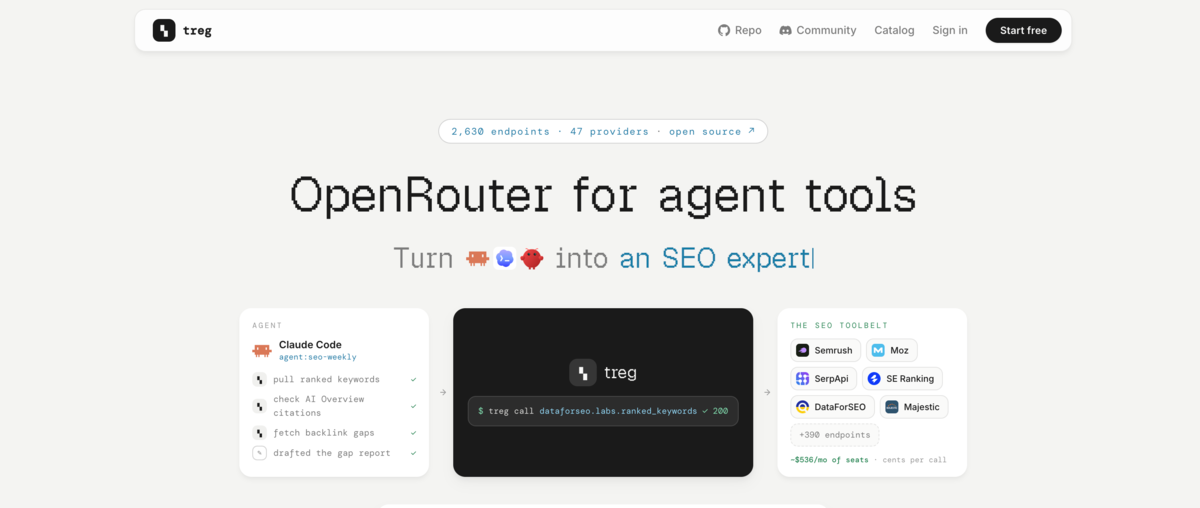
Treg is an open source tool gateway that connects coding agents such as Claude Code, Codex, OpenCode, and OpenClaw to more than 2,600 endpoints from 47 providers through one API key. Agents can access SEO data, social media analytics, sales intelligence, advertising platforms, image and video generation, and other specialized services without managing separate provider accounts. Treg compares providers by price, speed, and success rate to help the agent choose an appropriate tool for each task. It uses pay per result pricing and allows users to connect their own provider keys for unmetered access.
Treg Details
Reviewed by Add AI Directory Editorial Team
View our review methodology →Sources
- Official website
- DocumentationNot provided
- Pricing pageNot provided
- Privacy policyNot provided
- Terms / public policyNot provided
- Testing status
- Researched Only
- Availability status
- Not yet verified
- Limitations
- No additional limitations documented.
Ready to try Treg?
Check out Treg for pricing and explore how it can streamline your workflow.
Treg is an open source tool gateway that connects coding agents to more than 2,600 endpoints from dozens of data and software providers through one API key. It allows agents such as Claude Code, Codex, OpenCode, OpenClaw, Hermes, and Pi to access SEO data, sales intelligence, advertising platforms, social media data, content-generation models, and other specialized services.
What Is Treg?
Treg is a unified tool catalog and API gateway built for AI agents. It gives an agent access to specialized tools without requiring the user to create and manage a separate account, subscription, and API key for every provider.
The platform includes tools for keyword research, rank tracking, backlink analysis, contact enrichment, company research, ad management, social media publishing, analytics, and image or video generation. Its catalog contains more than 2,600 endpoints from dozens of providers.
Instead of requiring the user to select a provider manually, Treg can compare available options using factors such as price, response speed, and measured success rate. The agent can then choose a suitable provider for the requested task.
Treg uses a single credential across its tool catalog. Users who already have an account with a supported provider can connect their own API key and route eligible requests through that account.
Key Features
Unified Tool Catalog
Treg provides one catalog containing more than 2,600 endpoints from dozens of providers. Agents can search the catalog and select tools based on the task they need to complete.
One API Key
A single Treg credential can give an agent access to supported tools across the catalog. This reduces the need to store and manage separate provider credentials on the user’s computer.
Provider Comparison
Treg compares providers using information such as pricing, response speed, and measured success rate. This helps an agent choose between multiple providers that offer similar data or capabilities.
SEO and Search Data
Agents can access tools for keyword research, search volume, keyword difficulty, competitor analysis, rank tracking, backlink research, live search results, Google Search Console data, and AI visibility monitoring.
Sales and Company Intelligence
Treg includes endpoints for finding and verifying work emails, researching people and companies, reviewing funding information, identifying buying signals, and retrieving company data.
Advertising and Analytics
Agents can connect to supported advertising and measurement platforms to manage campaigns, inspect competitor advertisements, retrieve conversion data, and analyze performance.
Social Media Tools
The catalog includes endpoints for researching social media content, retrieving channel analytics, identifying trends, and publishing content to supported platforms.
Image and Video Generation
Treg gives agents access to supported image and video models through the same tool catalog. The agent can select an available provider based on the requested media task.
Bring Your Own Key
Users who already have credentials for a supported provider can connect their own key. Eligible requests can then be routed through the user’s existing provider account.
Open-Source Codebase
Treg is open-source software distributed under the GNU Affero General Public License. Its repository can be inspected, modified, and deployed according to the terms of that license.
Treg Use Cases
Treg can be used to:
- Give coding agents access to external tools and data
- Perform keyword and competitor research
- Track search rankings and backlinks
- Retrieve Search Console and analytics data
- Research companies, contacts, and buying signals
- Find and verify professional email addresses
- Manage supported advertising campaigns
- Research trends across social platforms
- Publish content to supported social networks
- Generate images and videos
- Compare similar providers by price and performance
- Reduce the number of API keys managed locally
- Route requests through existing provider accounts
- Build workflows that require tools from multiple providers
How Treg Works
A user creates a Treg account and gives a supported coding agent the Treg setup instructions. The agent receives a single credential that can be used to access tools within the catalog.
When the user asks the agent to complete a task, the agent searches Treg for an appropriate endpoint. If multiple providers can perform the same task, Treg supplies information about their pricing, speed, and measured success rate. The agent can use that information to select a provider.
Treg then routes the request to the selected service and returns the result to the agent. Provider credentials are injected on the server rather than stored directly on the user’s computer.
Users can also connect their own provider keys. When an eligible personal key is available, Treg can route the request through that provider account instead of using Treg’s metered access.
Treg Pricing
Treg uses a usage-based pricing model rather than requiring one subscription for the entire catalog.
Users pay for individual provider requests, with the price shown before a tool is called. Costs vary according to the endpoint and provider selected.
Treg includes starter credit for new users. Users can also connect their own supported provider keys, allowing eligible calls to use their existing accounts.
Limitations
Treg depends on third-party providers to supply many of the tools and datasets in its catalog. Endpoint availability, response speed, accuracy, and usage limits can therefore vary by provider.
Some tools require OAuth authorization or a connected account before an agent can access personal data, publish content, or manage advertising campaigns.
Usage costs can vary considerably across endpoints. Workflows that make frequent calls or use expensive providers may consume more credit than simple research tasks.
Provider comparison data can help an agent select a tool, but measured success rate and speed do not guarantee that every request will return a complete or accurate result.
Connecting an agent to external tools can allow it to retrieve data or perform actions on the user’s behalf. Users should review connected accounts, permissions, and agent instructions before enabling tools that can publish content or change campaigns.
Who Is Treg For?
Treg is designed for developers, marketers, founders, agencies, sales teams, and technical users who want AI agents to work with external tools and business data.
It is especially useful for people using coding agents such as Claude Code, Codex, OpenCode, OpenClaw, Hermes, or Pi who do not want to configure a separate integration for every service.
Treg may also be useful for teams building multi step agent workflows that combine SEO research, analytics, sales intelligence, advertising data, social publishing, and media generation.
Ready to try Treg?
Check out Treg for pricing and explore how it can streamline your workflow.
Explore More AI Agents
Discover other AI agents and tools to enhance your workflow and productivity.
Browse All AgentsSimilar to Treg

Screenpipe
Screenpipe is a source-available desktop app that records and indexes screen activity, app text, meetings, and audio to create a searchable history of your work. Captured data stays on your device by default and can be selectively shared with Claude, Codex, Cursor, ChatGPT, and other MCP-compatible AI assistants. Screenpipe also supports recurring workflows based on captured activity, local transcription, accessibility text extraction, and OCR. Optional paid plans add features such as extended history, additional AI capacity, cross-device syncing, and team workflows.

Vibekit
VibeKit is a hosted AI coding platform that gives each web app its own persistent AI agent and development environment. Users can build, edit, deploy, and maintain web apps from a phone or browser without keeping their own computer online. VibeKit supports GitHub integration, scheduled tasks, databases, MCP, environment variables, custom domains, and bring your own API keys for supported AI providers. The platform is designed for developers and founders who want to build small web apps, PWAs, prototypes, or internal tools with an AI coding agent that can continue working across sessions.

Agentskills Codes
agentskills.codes is an open registry for discovering and installing reusable Agent Skills for AI coding assistants such as Claude Code, Codex, and GitHub Copilot. It helps developers compare skills, review source and compatibility information, check safety and repository health signals, and install portable skills for coding and agent workflows.
Trending AI Agents

Kolz AI
Kolz AI is an AI voice calling platform for outbound sales and lead qualification. It lets teams upload CSV or Excel contact lists and automatically call prospects using AI voice agents. Instead of manually working through large lead lists, users can launch calling campaigns that qualify leads, handle conversations, and identify higher-intent prospects. Kolz returns lead scores, call summaries, transcripts, recordings, and campaign results so sales teams can focus their time on the contacts most likely to convert.

Webhub
WebHub is an AI-powered no-code website builder that helps users create, edit, and manage websites without writing code. It combines AI-assisted site generation with visual editing, built-in hosting, and tools for improving website content and search visibility.

ListingBott
ListingBott is an AI-powered SEO tool that automates directory submissions to 100+ sites, helping you earn quality backlinks, boost domain authority, and increase online visibility—all with one click.