
Placement API

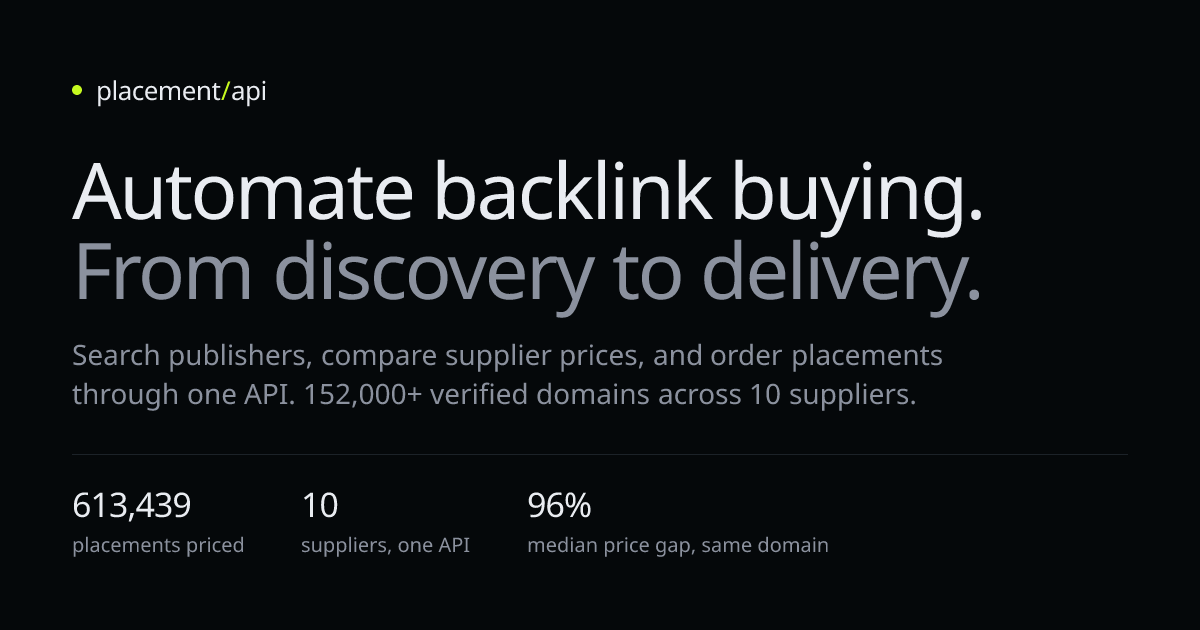
Placement API is an API and hosted MCP server that lets AI agents and SEO tools research and buy backlink placements. Agents can search publishers from 10 suppliers, compare supplier prices for the same domain, and turn a brief into a priced link plan with suspect domains filtered out. Read-only keys handle research, while purchases need a separate order key, prepaid credits, and server-enforced spending caps. Searching the catalogue and signing up are free.
Placement API Details
Reviewed by Add AI Directory Editorial Team
View our review methodology →- Testing status
- Researched Only
- Availability status
- Not yet verified
- Limitations
- No additional limitations documented.
Ready to try Placement API?
Check out Placement API for pricing and explore how it can streamline your workflow.
Placement API is an API and hosted MCP server that gives AI agents and SEO tools access to backlink placement research and purchasing. Agents can search publishers from 10 suppliers, compare supplier prices for the same domain, turn a brief into a priced link plan, and place and track orders through one integration.
It is infrastructure for agents rather than a standalone agent. You connect it to Claude, ChatGPT, Claude Code, Cursor, or another MCP host, or call the REST API from your own product. Searching the catalogue and signing up are free, while purchases are paid with prepaid credits on a key that has ordering permission.
What Is Placement API?
Placement API aggregates link placement inventory, such as guest posts, link insertions, niche edits, and homepage links, from third-party marketplaces into one catalogue with a single balance and invoice. The same domain often appears in several supplier catalogues at different prices, so Placement API shows those offers side by side and routes to the lowest available price.
Every domain is also screened independently. Placement API checks domains against five tests using search traffic, ranking keywords, backlink signals, and the public web graph. Domains whose authority is not backed by organic search presence are flagged as suspect and left out of generated plans by default. The service is operated by Future Bets, Inc.
How Placement API Works
A user creates a free account and gets an API key. A read-only key can search placements, compare domains, and build plans. Posting a brief with criteria such as topic, authority, budget, and number of links returns a priced plan of named domains, each with a short reason it was picked, and the quoted prices are held for four hours.
Buying requires a separate key with the order scope. Orders are charged at the held price inside per-order and daily spending caps that are enforced server-side, and required idempotency keys stop a retried request from charging twice. Orders go to suppliers in a daily batch and can be cancelled for a full refund until then. After delivery, links are re-checked for up to a year for presence, dofollow status, and the agreed anchor text.
The hosted MCP server at api.placementapi.com/mcp exposes 20 tools over Streamable HTTP, with nothing to install. The five tools that can spend money only appear on keys with the order scope, so a read-only key left in a chat session cannot buy anything. A typed TypeScript client is published on npm and GitHub.
Key Features
- Cross-supplier search: Search placements by topic, authority, traffic, price, geography, and language across 10 suppliers, deduplicated by domain.
- Price comparison: See every listing for one domain, cheapest first, with the price spread and an authority verdict.
- Link planning: Turn a brief and budget into a costed basket of domains, with a reason for every line and prices held for four hours.
- Independent domain screening: Flag domains that fail five quality tests and exclude them from plans by default.
- Spending controls: Use read-only keys for research, separate order keys for purchasing, and per-order and daily caps enforced in the database.
- Ordering and delivery tracking: Place orders, submit or request articles, set up standing orders, and track delivery and later link checks in the same integration.
- SEO research tools: Review a page’s backlink profile, competitor link gaps, keyword winners, and, with Google Search Console connected, pages that a link could help.
- MCP and REST access: Connect through a hosted MCP server with 20 tools or a REST API with an OpenAPI schema and a TypeScript client.
Placement API Use Cases
- Let an AI agent move from an SEO audit to a priced backlink plan and approved purchases
- Compare what different marketplaces charge for a placement on the same domain
- Filter out publishers with inflated authority metrics before spending a link budget
- Manage link purchases across client campaigns with one balance, one invoice, and a shared order history
- Add placement discovery and purchasing to an SEO software product through an API
Who Is Placement API For?
Placement API is for SEO agencies, SEO software teams, and teams using AI agents for link building. It suits buyers who want to research and purchase backlinks programmatically, compare suppliers without checking each catalogue, and give an agent purchasing access while keeping firm limits on what it can spend.
Placement API Pricing
Signing up, getting an API key, and searching the catalogue are free. Reads are rate limited, with a monthly read allowance that grows with the credits purchased. There is no subscription. Placements are paid for with prepaid credits, where one credit equals one US cent, at the price shown on the quote.
Placement prices depend on the publisher, placement type, and topic. Placement API’s own pricing page lists a median placement price of around $150 across its catalogue at the time of listing. Having an article written for an order costs a flat 1,500 credits. Unspent purchased credits do not expire and can be refunded in cash within 90 days of the top-up, less a 5% handling charge. Placement API also returns a share of supplier volume discounts to buyers as credits after delivery.
Limitations
Placement API is a purchasing tool, not a guarantee of results. Its terms state that it does not promise rankings, and buying links carries risk under the guidelines of major search engines, which buyers have to judge for themselves. Domain metrics are estimates, and a legitimate site can be flagged by the quality screening.
Suppliers are never identified, so buyers cannot see which marketplace fulfils an order. Credits are charged when an order is placed, and once an order has reached a supplier, refunds for undelivered work depend on recovering the funds from that supplier. The service itself is not open source; only the TypeScript client and MCP manifest are public under the MIT license.
Key Features of Placement API
- Search backlink placements across 10 suppliers, deduplicated by domain
- Side-by-side supplier price comparison for the same domain
- Priced link plans from a brief, with quotes held for four hours
- Independent five-test domain screening that flags suspect authority
- Separate read and order keys with server-enforced spending caps
- Ordering, content submission, standing orders, and delivery tracking
- Backlink gap, keyword, and Google Search Console research tools
- Hosted MCP server with 20 tools, REST API, and TypeScript client
Ready to try Placement API?
Check out Placement API for pricing and explore how it can streamline your workflow.
Placement API Alternatives
- ListingBott
ListingBott is an AI-powered SEO tool that automates directory submissions to 100+ sites, helping you earn quality backlinks, boost domain authority, and increase online visibility—all with one click.
- Frase
Frase is an AI content tool that helps you research, write, and optimize content for SEO.
- Surfer SEO
Surfer SEO is a content optimization tool that helps you rank higher on Google.
Explore More AI Agents
Discover other AI agents and tools to enhance your workflow and productivity.
Browse all AI agentsSimilar to Placement API

Arvow
Arvow is an AI SEO platform for marketers and agencies. Its agents help research, write, and publish content in a brand’s voice, identify technical SEO issues, and find relevant sites for contextual backlinks. Arvow also tracks brand mentions across AI search tools, bringing content, site optimization, link building, and AI visibility into one platform.
Google Ads Advisor
Google Ads Advisor and Analytics Advisor are AI powered assistants that help advertisers optimize campaigns, understand data, and make faster decisions across Google Ads and Google Analytics. They combine generative AI, real time insights, and account level learning to simplify how marketers manage performance. By integrating optimization tools, conversational analysis, and automated recommendations, the advisors make it easier to create high quality assets, discover growth opportunities, troubleshoot issues, and improve results. With personalized guidance, natural language interaction, and automated actions, these AI agents help teams streamline workflows, reduce manual effort, and scale more effective advertising strategies.

Nxtscape
Nxtscape is a local first AI browser that runs autonomous agents directly on your device. It helps you automate tasks like research, form filling, and summarization while keeping your data private. No coding or cloud required.
Trending AI Agents

Revenue Scout
Revenue Scout is your Agentic Coworker for sales prospecting. Scout finds people already discussing a need your business can meet, shows why each match fits, and prepares reply drafts for you to review, edit, and post yourself.

Robylon
Robylon is an AI customer support platform whose agents work across email, chat, voice, and WhatsApp. They can take real actions in connected tools, such as refunds and ticket updates, and hand unfinished work to a person with the full conversation attached.

CorpusIQ
CorpusIQ is an MCP server that answers business questions inside ChatGPT, Claude, and Perplexity by retrieving live data from the systems a team already uses. Every number comes with a cited source, and connected accounts are authorized through read only OAuth.