
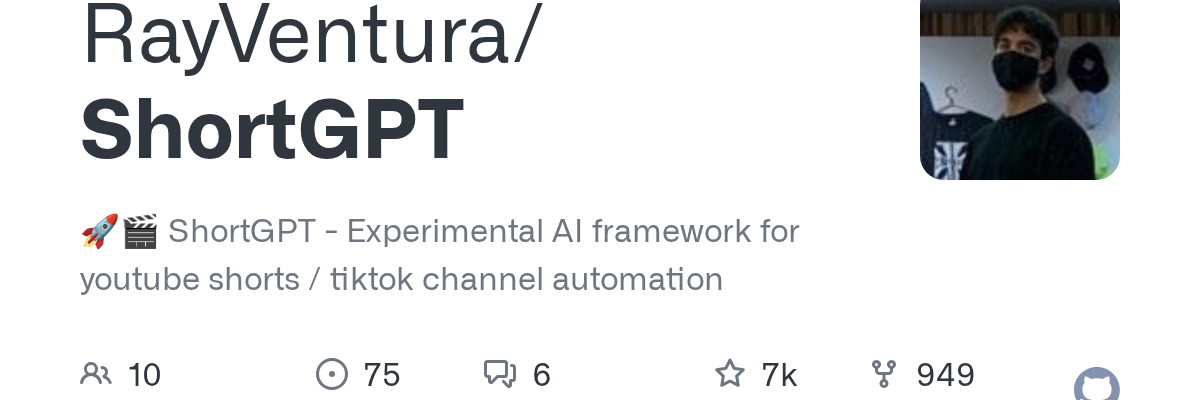
ShortGPT

ShortGPT is a powerful automated video content creation framework for short-form media. It combines script generation, voice synthesis, asset sourcing, editing logic, and translation into a unified pipeline. By enabling creators to produce polished short videos rapidly, ShortGPT helps scale content strategies across languages and platforms with less manual work.
ShortGPT Details
Overview of ShortGPT
ShortGPT is an open source artificial intelligence framework for automating video production. It helps creators generate scripts, produce voiceovers, source visual assets, create captions, edit footage, and render complete videos through a structured workflow.
The framework is particularly useful for producing YouTube Shorts, TikTok videos, narrated social media content, faceless videos, and translated versions of existing content. Instead of completing every production task manually, creators can use ShortGPT to coordinate multiple tools and automate repetitive parts of the creative process.
ShortGPT is designed as a flexible framework rather than a basic video generator. Users can configure content engines, language models, voice services, media sources, editing instructions, and output preferences based on their projects. This makes it suitable for both individual creators and developers building larger content automation systems.
What Is ShortGPT
ShortGPT is an artificial intelligence video automation framework that converts ideas, topics, scripts, or existing videos into edited content. It brings together language models, voice synthesis services, media sourcing tools, caption generation, and video editing libraries within one production environment.
The framework can help generate a script, divide it into scenes, create a voiceover, locate relevant background footage, synchronize visuals with narration, generate captions, and prepare the final video. This reduces the number of separate applications creators need to use during production.
ShortGPT includes different engines for different content workflows. Its short content engine is designed for vertical videos and social media clips. Its longer video engine can assist with narrated videos that require additional footage, timing, and editing. A translation engine can transcribe an existing video, translate the spoken content, create a new voiceover, and add captions in another language.
The project also includes an automated editing engine that organizes editing instructions into structured blocks. This allows language models to understand and help control parts of the editing process. Developers can modify these instructions to create custom workflows, repeatable templates, and specialized content systems.
Because ShortGPT is open source, users can inspect the code, run it on their own environment, connect supported services, and customize how content is generated. It is intended for users who want more control than they would receive from a closed video generation platform.
How To Use ShortGPT
Using ShortGPT generally involves installing the framework, configuring the required services, selecting a content engine, entering project information, and reviewing the generated video.
Install ShortGPT
Users can run ShortGPT through a supported local environment, Docker setup, or Google Colab notebook. Google Colab can provide a more accessible starting point for users who do not want to configure every dependency directly on their computer.
A local installation provides more control over files, settings, processing, and integrations. Technical users can also modify the source code and build custom features around the framework.
Configure Your Services
ShortGPT may require access to external services depending on the selected workflow. Language model services can assist with script writing, scene planning, prompts, and editing instructions.
Voice synthesis services can convert generated scripts into spoken narration. Media providers can supply stock video clips and images that match the subject of each scene. Users should review the configuration area and provide the credentials required by the services they plan to use.
The exact setup can vary based on the selected content engine. A basic narrated short may require fewer services than a translated video or a longer production with automatically sourced footage.
Choose a Content Engine
Users can select the engine that best matches the type of video they want to create.
The short content engine is designed for concise videos that can be published on platforms such as YouTube Shorts and TikTok. It can assist with script creation, voiceover production, visual selection, captions, rendering, and video metadata.
The longer video engine is intended for content that requires more narration, additional scenes, background footage, and detailed timing. It can coordinate audio generation, visual sourcing, caption placement, and final rendering across a longer timeline.
The translation engine is used to create another language version of an existing video. It can process the original audio, translate the spoken content, generate a replacement voiceover, create captions, and export a new version.
Enter Your Video Topic
After choosing an engine, users can provide a topic, title, description, script, or existing video. Clear input generally gives the framework better direction when generating the structure of the content.
Creators can describe the audience, desired length, language, format, style, and main points that should appear in the video. They can also revise the generated script before allowing the system to continue with voice and visual production.
Generate the Script and Voiceover
ShortGPT can use a connected language model to create a script based on the supplied topic. The script may be separated into scenes or narration segments so that each section can be connected with appropriate visuals.
The selected voice synthesis service converts the script into narration. Depending on the service, users may be able to choose the voice, language, speaking style, and other audio settings.
Creators should listen to the voiceover and review pronunciation before producing the final video. Brand names, technical terms, locations, and uncommon names may require adjustments.
Source Visual Assets
ShortGPT can search connected media sources for footage and images related to the script. It can use the meaning of each scene to identify suitable visual material and place it within the project.
Automatically selected assets can reduce research time, but creators should still review the results. Visual relevance, licensing requirements, brand consistency, and overall quality should be checked before publishing.
Users can replace automatically sourced media with their own footage, graphics, screenshots, or images when they need greater creative control.
Create Captions
The framework can generate captions and synchronize them with the narration. Captions can make short videos easier to follow when viewers are watching without sound.
Users should check caption timing, spelling, placement, and readability. Captions should not cover important visual elements or sit outside the safe viewing area used by social media applications.
Review and Render the Video
Before rendering, creators can review the script, narration, visuals, captions, pacing, and other project settings. This step is important because automated content may still contain factual errors, awkward transitions, repetitive clips, or mismatched visuals.
Once the project is approved, ShortGPT can process the assets and render the completed video. The creator can then watch the exported file and make further revisions when needed.
ShortGPT Key Features
Automated Script Generation
ShortGPT can use language models to transform a topic or idea into a structured video script. This helps creators move from initial research to a usable narration draft more quickly.
Scripts can be divided into smaller scenes so the system can connect each section with visuals, captions, and audio. Users can edit the script before completing the rest of the workflow.
Video Editing Automation
The framework automates many repetitive editing tasks, including arranging footage, synchronizing narration, timing captions, preparing background assets, and rendering the finished video.
ShortGPT uses video processing libraries and structured editing instructions to coordinate these tasks. Developers can customize the editing logic for different formats, templates, and production requirements.
Short Video Production
ShortGPT includes a content engine focused on vertical short videos. It can help create content for YouTube Shorts, TikTok, Instagram Reels, and similar platforms.
This workflow can include topic generation, script writing, narration, visual sourcing, caption creation, editing, rendering, and preparation of publishing metadata.
Longer Video Workflows
The framework can also support longer narrated videos. Its longer video engine can manage additional scenes, larger scripts, more background footage, and extended audio timing.
This can be useful for educational content, explainers, commentary videos, tutorials, list based videos, and other formats that require more structure than a short social media clip.
Artificial Intelligence Voiceovers
ShortGPT can connect with voice synthesis services to generate narration. Supported options can provide different voices, languages, accents, and levels of natural speech quality.
The voiceover can be generated directly from the script and incorporated into the editing workflow. This allows creators to produce narrated content without recording every line manually.
Multilingual Content Creation
The framework supports voice and content workflows across many languages. Creators can use it to produce localized videos for audiences in different countries and regions.
Available language support depends partly on the connected voice synthesis provider. Users should review pronunciation and translation quality before publishing localized content.
Video Translation and Dubbing
The translation engine can process an existing video and create a new version in another language. The workflow may include transcription, translation, voice generation, caption creation, and video rendering.
This feature can help creators repurpose successful videos for new audiences without rebuilding the project from the beginning.
Automatic Caption Generation
ShortGPT can generate captions that follow the timing of the narration. Captions improve accessibility and help viewers understand videos when audio is muted or difficult to hear.
Creators can review the caption text and presentation before exporting the final project.
Visual Asset Sourcing
The framework can retrieve relevant images and video footage through connected media services. It uses the script and scene context to search for material that supports the narration.
This can reduce the time spent manually searching stock libraries. Users can still replace suggested assets when they need a specific visual style or stronger brand consistency.
Editing Markup Language
ShortGPT uses a structured editing approach that breaks video instructions into understandable blocks. This helps language models and automation systems interact with the editing process.
The structure can make it easier for developers to build reusable workflows and modify individual parts of a project without rebuilding the entire production system.
Customizable Production Workflows
Since ShortGPT is an open source framework, developers can change how scripts, voices, assets, captions, and editing instructions are handled.
Custom workflows can be built for specific niches, content formats, languages, brands, or publishing strategies. This flexibility separates ShortGPT from tools that only provide a fixed generation process.
Local and Cloud Based Setup Options
ShortGPT can be used through local installation methods, Docker, or supported cloud notebook environments. Users can choose an approach based on their technical experience and computing resources.
A local setup can provide greater control over files and customizations, while a notebook environment may make testing the framework easier.
ShortGPT Use Cases
YouTube Shorts Automation
Creators can use ShortGPT to produce short vertical videos for YouTube. The framework can assist with scripts, voiceovers, footage, captions, rendering, and metadata.
This can help channels publish more consistently, especially when working with repeatable educational, entertainment, news commentary, or list based formats.
TikTok Content Production
ShortGPT can support automated TikTok video workflows. Creators can generate short scripts, add narration, locate supporting footage, create captions, and export a completed video.
The final content should still be reviewed and adapted to match current platform formats, audience expectations, and publishing guidelines.
Faceless Video Channels
Faceless content channels can use ShortGPT to produce narrated videos without showing an on camera presenter. The creator can supply a topic while the framework helps generate the script, voiceover, visuals, and captions.
This approach can be used for explainers, educational clips, facts, stories, software topics, business content, and other narration focused formats.
Educational Videos
Teachers, course creators, and educational publishers can use ShortGPT to turn a concept into a narrated video. The framework can organize a topic into scenes and connect the explanation with supporting visuals.
Creators should verify all educational claims and ensure that the selected assets accurately represent the subject.
Product Explainer Videos
Businesses can use ShortGPT to draft short product explainers and feature demonstrations. A script can introduce the problem, present the product, explain important features, and include a clear next step.
Companies can replace automatically sourced media with product footage, screenshots, brand graphics, and customer examples.
Social Media Content Repurposing
A longer article, video, podcast topic, or educational resource can be adapted into several short videos. ShortGPT can help turn individual ideas into separate scripts and production workflows.
This allows creators to build more content from existing research while adjusting the format for different social media platforms.
Multilingual Channel Expansion
Creators can translate and dub existing videos for viewers who speak other languages. This can help a channel test new markets and reach audiences beyond its original language.
Each translated version should be reviewed by someone familiar with the target language, especially when the content includes humor, technical terminology, cultural references, or persuasive messaging.
Content Agencies
Marketing and video agencies can use ShortGPT as part of a repeatable production system. Teams can create templates for different clients, industries, platforms, and content types.
Human review remains important for brand accuracy, visual quality, factual verification, and client approval.
Video Prototyping
Creators can use ShortGPT to build a rough version of a video before investing in a complete manual edit. The generated script, narration, captions, and visual sequence can help test whether an idea works.
The prototype can then be refined with custom footage, improved writing, professional audio, and more detailed editing.
Developer Built Video Applications
Developers can use ShortGPT as a foundation for custom video tools. Its engines and structured editing workflow can be incorporated into internal systems, creator platforms, media applications, and automated publishing pipelines.
Because the framework is open source, development teams can inspect its components and modify them for specialized requirements.
ShortGPT FAQ
Is ShortGPT a video generator?
ShortGPT is an artificial intelligence video automation framework. It coordinates script generation, voice creation, asset sourcing, captions, editing, and rendering. It is broader than a simple text to video generator because users can configure and customize the production workflow.
Is ShortGPT free?
ShortGPT is available as an open source project. However, users may still need to pay for external language models, voice services, stock media services, computing resources, or other connected tools.
The total cost depends on the services selected and the number of videos being produced.
Does ShortGPT require technical experience?
Some technical knowledge can be helpful, especially when installing the project locally, using Docker, managing dependencies, entering service credentials, or modifying the source code.
Google Colab or a prepared interface may make initial testing easier, but users should still expect more setup than they would encounter with a fully managed online video editor.
Can ShortGPT create YouTube Shorts?
Yes. ShortGPT includes an engine designed for producing short videos. It can assist with script creation, voiceovers, footage selection, captions, editing, rendering, and video metadata.
Creators should review the completed video before uploading it to YouTube.
Can ShortGPT create TikTok videos?
Yes. ShortGPT can be used to create short vertical videos that may be published on TikTok. Users can configure the topic, narration, visuals, captions, and other production elements.
The exported video may require additional adjustments based on the creator’s preferred format and current TikTok requirements.
Can ShortGPT create longer videos?
Yes. ShortGPT includes a video engine designed for longer content. It can manage larger scripts, narration, background footage, captions, timing, and rendering.
Production time and computing requirements may increase as the video becomes longer and more complex.
Can ShortGPT translate existing videos?
Yes. Its translation engine is designed to transcribe video audio, translate the content, create a new voiceover, add captions, and render another language version.
Translation quality should be checked carefully before publication.
Does ShortGPT generate voiceovers?
Yes. ShortGPT can connect with supported voice synthesis services to generate narration from a script. Available voices and languages depend on the selected provider.
Does ShortGPT find stock footage automatically?
ShortGPT can connect with media sources to retrieve images and video footage that relate to the script. Creators should review each selected asset for relevance, quality, licensing, and brand suitability.
Can I use my own footage?
Yes. Users can incorporate their own videos, images, graphics, screenshots, and other assets into a ShortGPT workflow. Custom media can provide greater control over visual quality and brand consistency.
Can developers customize ShortGPT?
Yes. ShortGPT is an open source framework, so developers can modify its source code, editing logic, prompts, integrations, engines, and output settings.
This makes it useful for experimentation and custom video automation projects.
Is ShortGPT suitable for beginners?
ShortGPT may be useful for beginners who are comfortable following installation instructions and configuring external services. However, it is more technical than many hosted video creation platforms.
Users with no development experience may need additional assistance during setup.
Does ShortGPT publish videos automatically?
ShortGPT primarily focuses on content generation and video production. Publishing options may depend on the workflow, custom integrations, and version being used.
Creators should review each video and platform setting before publishing content automatically.
Does ShortGPT replace a video editor?
ShortGPT can automate many editing tasks, but it may not replace a professional editor in every situation. Complex storytelling, advanced motion graphics, original filming, detailed sound design, and precise brand work may still require manual editing.
It is most useful for accelerating repetitive production tasks and creating structured first versions of videos.
Should ShortGPT videos be reviewed before publishing?
Yes. Creators should check scripts, facts, pronunciation, captions, visuals, audio timing, licensing, and overall quality before publishing.
Artificial intelligence systems can produce incorrect information or select media that does not accurately match the narration. Human review helps protect content quality and brand credibility.
Explore More AI Agents
Discover other AI agents and tools to enhance your workflow and productivity.
Browse All AgentsRelated AI Agents
View All Agents →
Tale
Tale is an open-source project workspace for teams and AI agents. Teammates plan tasks on a shared board, assign work to people or agents, and review the results together, while agents run in persistent sandboxes using runtimes such as Claude Code and Codex. It combines task boards, shared knowledge, workflows, and governance controls, and can be self-hosted with Docker or run as managed Cloud. Tale is MIT licensed, and the free Community edition includes every feature.

VoiceDrop
VoiceDrop is a ringless voicemail and SMS platform built for sales teams. It clones a user’s voice from roughly a 30-second sample and delivers personalized voicemails to US mobile and VoIP numbers without ringing the phone, with two-way SMS in the same workflow. Billing applies only to successful deliveries, and the platform includes SOC 2 Type II compliance, Do Not Call suppression, phone validation, a REST API, and Zapier and Make integrations.

Arvow
Arvow is an AI SEO platform for marketers and agencies. Its agents help research, write, and publish content in a brand’s voice, identify technical SEO issues, and find relevant sites for contextual backlinks. Arvow also tracks brand mentions across AI search tools, bringing content, site optimization, link building, and AI visibility into one platform.
Trending AI Agents
View All Agents →
Site Speak
SiteSpeak AI lets you train a custom chatbot on your website content, FAQs, and documents. Site Speak AI can answer visitor questions instantly, 24/7, with no coding required.

Murf AI
Murf AI is a text-to-speech platform that transforms written content into lifelike voiceovers. It’s perfect for creators, educators, and businesses needing high quality narration without recording audio manually.
Synthesia
Synthesia is an AI video generation platform that lets users create professional-looking videos using realistic AI avatars. It enables anyone to turn text into engaging videos in minutes—no cameras, microphones, or actors required.
Tale
Tale is an open-source project workspace for teams and AI agents. Teammates plan tasks on a shared board, assign work to people or agents, and review the results together, while agents run in persistent sandboxes using runtimes such as Claude Code and Codex. It combines task boards, shared knowledge, workflows, and governance controls, and can be self-hosted with Docker or run as managed Cloud. Tale is MIT licensed, and the free Community edition includes every feature.
VoiceDrop
VoiceDrop is a ringless voicemail and SMS platform built for sales teams. It clones a user’s voice from roughly a 30-second sample and delivers personalized voicemails to US mobile and VoIP numbers without ringing the phone, with two-way SMS in the same workflow. Billing applies only to successful deliveries, and the platform includes SOC 2 Type II compliance, Do Not Call suppression, phone validation, a REST API, and Zapier and Make integrations.
Arvow
Arvow is an AI SEO platform for marketers and agencies. Its agents help research, write, and publish content in a brand’s voice, identify technical SEO issues, and find relevant sites for contextual backlinks. Arvow also tracks brand mentions across AI search tools, bringing content, site optimization, link building, and AI visibility into one platform.