
Vibekit

VibeKit is a hosted AI coding platform that gives each web app its own persistent AI agent and development environment. Users can build, edit, deploy, and maintain web apps from a phone or browser without keeping their own computer online. VibeKit supports GitHub integration, scheduled tasks, databases, MCP, environment variables, custom domains, and bring your own API keys for supported AI providers. The platform is designed for developers and founders who want to build small web apps, PWAs, prototypes, or internal tools with an AI coding agent that can continue working across sessions.
Vibekit Details
Overview of Vibekit
VibeKit is a hosted AI coding agent platform that gives each web app its own persistent AI agent and isolated development environment. The agent can edit code, inspect logs, run tasks, and deploy changes while VibeKit keeps the application running on its hosted infrastructure.
What Is VibeKit?
VibeKit allows developers and founders to build and maintain web applications without keeping their own computer online. Each project receives a dedicated container and persistent AI agent that retains access to the application's codebase between sessions.
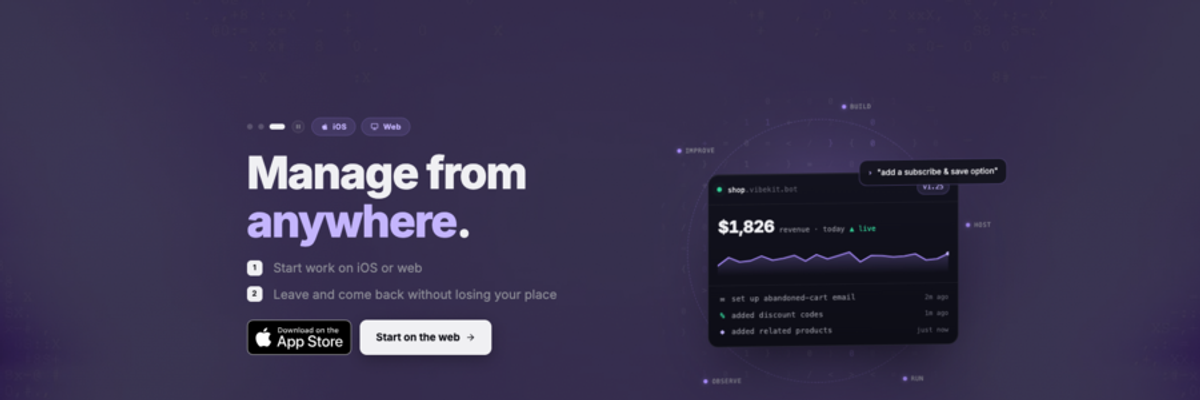
Users can interact with the agent through VibeKit's iOS app, web dashboard, CLI, REST API, or MCP. A user can ask the agent to modify an application, fix a bug, add a feature, or deploy a change from a phone or browser.
VibeKit can create or connect to a GitHub repository, commit changes to the repository, and automatically redeploy an application after changes are pushed. The GitHub repository remains under the user's account and serves as the source of truth for the project's code.
Key Features
Persistent AI Agent Per App
VibeKit assigns a separate AI coding agent to each application. The agent works inside that application's environment and maintains project context across sessions instead of operating as one shared assistant across unrelated projects.
Hosted Development Environment
VibeKit runs application containers on its own infrastructure. Users do not need to keep a laptop, desktop, or home server running for the agent or deployed application to remain available.
Build and Deploy From a Phone
VibeKit provides an iOS application alongside its web interface. Developers can send coding instructions, review a project, and initiate changes without working directly from a traditional development machine.
GitHub Integration
VibeKit can work with a GitHub repository owned by the user. The agent can edit files, create commits, work with branches, and deploy changes after pushes to the repository. Existing GitHub repositories can also be connected to the platform.
MCP, CLI and API Access
Developers can interact with VibeKit through MCP, a command line interface, and a REST API in addition to the web and mobile interfaces. This allows VibeKit agents to participate in broader AI agent and development workflows.
Scheduled Agent Tasks
VibeKit agents can perform work on a schedule in addition to responding to direct requests. This makes the platform suitable for applications that require recurring maintenance or automated development tasks.
Bring Your Own AI Key
VibeKit supports bring your own key access for supported Anthropic and OpenAI credentials. With BYOK, AI usage is billed directly through the provider without an additional VibeKit markup. Users who do not want to supply their own credentials can use VibeKit's platform billing instead.
VibeKit Use Cases
VibeKit can be used to:
- Build and deploy small web applications from a phone or browser
- Create internal business tools with an AI coding agent
- Maintain an application with a persistent agent between work sessions
- Run an AI coding agent without maintaining an always-on computer
- Connect an existing GitHub project to a hosted AI development environment
- Automate recurring development and maintenance tasks
- Build prototypes and PWAs
- Deploy applications directly to hosted URLs
How VibeKit Works
A user creates an application or connects an existing GitHub repository. VibeKit provisions a hosted container for the project and assigns a persistent AI agent to that environment.
The user then gives the agent instructions through chat or one of VibeKit's developer interfaces. The agent can inspect the existing project, edit files, run commands, test changes, and deploy the updated application.
Applications can run on a vibekit.bot subdomain, while paid plans support additional deployment options such as custom domains.
VibeKit Pricing
VibeKit uses a Free + Paid pricing model.
The Free plan starts at $0 per month. VibeKit currently lists its Builder plan at $19.99 per month and its Pro plan at $49.99 per month.
AI usage can work differently from the platform subscription. Users who bring supported provider credentials can pay the AI provider directly with no VibeKit markup. When VibeKit provides paid model access through its platform billing system, non-free model usage is charged at the underlying provider cost plus a platform markup.
Limitations
VibeKit runs source code on hosted infrastructure rather than exclusively on a user's local computer. Developers whose security requirements prohibit source code from leaving a local machine may need a locally operated alternative.
The platform focuses on web applications and hosted development workflows. It should not be confused with a general-purpose Linux environment or a tool for producing native App Store application binaries.
Free usage is also subject to platform limits, so developers building or maintaining multiple production applications may require a paid plan.
VibeKit's zero-markup AI pricing specifically applies to supported bring-your-own-key usage. Platform-provided paid AI access uses a separate billing model.
Who Is VibeKit For?
VibeKit is designed for developers, founders, technical teams, and independent builders who want an AI coding agent that remains attached to a project and runs in a hosted environment.
It is especially useful for users who want to build or maintain web applications from a phone, keep an AI development agent available between sessions, or avoid maintaining a dedicated computer for long-running AI coding workflows.
Category
Agent Tools
Pricing
Free + Paid
Free plan available. Paid plans start at $19.99/month.
Availability
Public
VibeKit is available through its web interface and iOS application.
Explore More AI Agents
Discover other AI agents and tools to enhance your workflow and productivity.
Browse All AgentsRelated AI Agents
View All Agents →
Arvow
Arvow is an AI SEO platform for marketers and agencies. Its agents help research, write, and publish content in a brand’s voice, identify technical SEO issues, and find relevant sites for contextual backlinks. Arvow also tracks brand mentions across AI search tools, bringing content, site optimization, link building, and AI visibility into one platform.
GenFlick
GenFlick is an AI filmmaking workspace for creating films, series, and video projects. Creators can develop a story with an AI Director, plan scenes, generate and edit footage, and publish finished work to a public viewing page. The platform also supports series planning, team collaboration, social publishing, fundraising, and creator monetization.
Lazy Ads
Lazy Ads is an AI media buyer that helps businesses run and optimize campaigns across nine ad networks from one platform. Users connect their own ad accounts, while paid plans provide an AI agent for campaign management. Teams that already use an AI agent can connect it through Lazy Ads’ MCP bridge. Pricing is a fixed monthly fee rather than a percentage of ad spend.
Trending AI Agents
View All Agents →
Site Speak
SiteSpeak AI lets you train a custom chatbot on your website content, FAQs, and documents. Site Speak AI can answer visitor questions instantly, 24/7, with no coding required.
Murf AI
Murf AI is a text-to-speech platform that transforms written content into lifelike voiceovers. It’s perfect for creators, educators, and businesses needing high quality narration without recording audio manually.
Synthesia
Synthesia is an AI video generation platform that lets users create professional-looking videos using realistic AI avatars. It enables anyone to turn text into engaging videos in minutes—no cameras, microphones, or actors required.
Arvow
Arvow is an AI SEO platform for marketers and agencies. Its agents help research, write, and publish content in a brand’s voice, identify technical SEO issues, and find relevant sites for contextual backlinks. Arvow also tracks brand mentions across AI search tools, bringing content, site optimization, link building, and AI visibility into one platform.
GenFlick
GenFlick is an AI filmmaking workspace for creating films, series, and video projects. Creators can develop a story with an AI Director, plan scenes, generate and edit footage, and publish finished work to a public viewing page. The platform also supports series planning, team collaboration, social publishing, fundraising, and creator monetization.
Lazy Ads
Lazy Ads is an AI media buyer that helps businesses run and optimize campaigns across nine ad networks from one platform. Users connect their own ad accounts, while paid plans provide an AI agent for campaign management. Teams that already use an AI agent can connect it through Lazy Ads’ MCP bridge. Pricing is a fixed monthly fee rather than a percentage of ad spend.