
Mem0

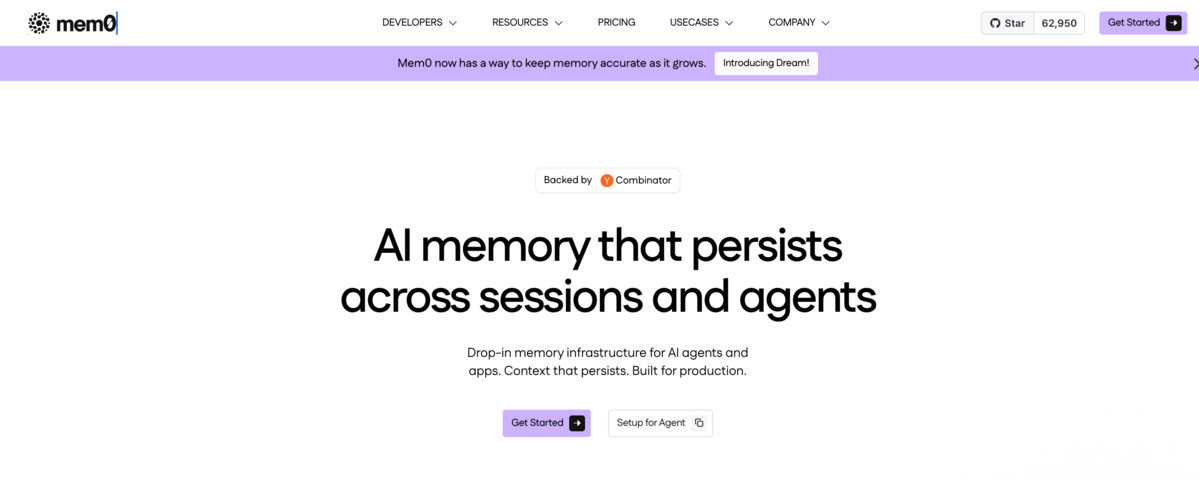
Mem0 is an AI memory layer for applications and agents that enables persistent, personalized context across conversations and sessions. It helps developers build AI systems that can remember user preferences, previous interactions, decisions, and other relevant information over time. Mem0 provides APIs and SDKs for storing, retrieving, updating, and managing memories, making it useful for AI assistants, customer support systems, personalized agents, and other context-aware AI applications.
Mem0 Details
Reviewed by Add AI Directory Editorial Team
View our review methodology →Sources
- Official website
- Documentation
- Pricing page
- Privacy policy
- Terms / public policyNot provided
- Testing status
- Researched Only
- Availability status
- Not yet verified
- Limitations
- No additional limitations documented.
Ready to try Mem0?
Check out Mem0 for pricing and explore how it can streamline your workflow.
Mem0 is an AI memory infrastructure platform that gives AI agents and applications persistent memory across conversations and sessions. It allows developers to store useful information from previous interactions and retrieve the most relevant memories when an AI system needs additional context.
Instead of repeatedly sending an entire conversation history to a language model, applications can use Mem0 to extract and store durable information such as user preferences, decisions, account details, goals, and previous interactions. Relevant memories can then be retrieved and added to the model context when needed.
What Is Mem0?
Mem0 is a memory layer designed for AI agents, assistants, chatbots, and other AI powered applications.
The platform sits between an application and its underlying AI model. Developers can send conversations or messages to Mem0, which can extract useful facts and store them as memories. Before a future model request, the application can search those stored memories and retrieve information relevant to the current interaction.
Mem0 supports memory scoped to users, agents, applications, and individual runs. This makes it possible to create AI systems that remember different information for different users or agents instead of treating every conversation as a new session.
Mem0 offers both a managed platform and open source tools. The managed platform handles infrastructure such as vector storage, retrieval, reranking, scaling, and memory management for developers.
How To Use Mem0
Developers can integrate Mem0 through its SDKs, REST API, CLI, or supported agent framework integrations.
A typical workflow begins by creating a Mem0 account and API key. Developers can then install the Python or JavaScript SDK and connect Mem0 to their application.
When an interaction contains information worth remembering, the application sends the messages to Mem0 using an add operation. Mem0 can extract individual facts and store them as memories.
Before generating a future response, the application can search Mem0 using the current query and user or agent identifiers. Relevant memories are returned and can then be included in the context provided to the language model.
Mem0 also provides operations for updating, deleting, searching, and managing existing memories through its API.
Mem0 Key Features
Persistent AI Memory
Mem0 enables AI applications to retain useful context after an individual conversation or session has ended.
User Specific Memory
Developers can associate memories with individual users so an AI assistant can recall preferences, previous decisions, goals, and other relevant information during later conversations.
Agent Memory
Memories can also be scoped to individual AI agents, applications, or runs, allowing developers to control where different types of contextual information are stored and retrieved.
Memory Extraction
Mem0 can analyze incoming conversations and convert useful information into structured memories rather than simply storing an entire transcript.
Semantic Memory Search
Applications can search stored memories and retrieve information based on its relevance to the current query.
Memory Management API
Mem0 provides REST APIs for creating, searching, updating, deleting, and managing memories across users and agents.
Python and JavaScript SDKs
Developers can integrate Mem0 into applications through supported Python and JavaScript packages.
Agent Framework Integrations
Mem0 can be integrated with AI agent frameworks and systems including LangChain, CrewAI, LangGraph, and the OpenAI Agents SDK.
Managed Infrastructure
The hosted Mem0 Platform manages supporting infrastructure such as vector storage and retrieval systems, reducing the amount of memory infrastructure developers need to operate themselves.
Memory Compression
Mem0 can condense conversation history into smaller memories so applications can retrieve relevant information without continuously placing the complete conversation history inside the prompt.
Mem0 Use Cases
AI Assistants
Personal AI assistants can use Mem0 to remember user preferences, previous questions, goals, and other information across separate conversations.
Personalized AI Agents
Developers can build agents that adapt their responses based on information collected through previous interactions with each user.
Customer Support
Support agents can retain customer preferences, previous interactions, account context, and unresolved issues across conversations.
Enterprise AI Applications
Organizations can use persistent memory to provide internal AI systems with contextual information that remains available between sessions.
Conversational AI
Chatbots can retrieve relevant memories from previous conversations instead of forcing users to repeatedly provide the same information.
AI Recommendation Systems
Applications can remember preferences and previous choices to produce recommendations that are more relevant to individual users.
Long Running AI Agents
Agents performing tasks over extended periods can retain decisions, objectives, instructions, and other useful information between runs.
Mem0 Pricing
Mem0 currently offers several hosted pricing tiers.
Hobby: Free. Includes unlimited end users, up to 10,000 add requests per month, 1,000 retrieval requests per month, one project, and community support.
Starter: $19 per month. Includes up to 50,000 add requests per month, 5,000 retrieval requests per month, one project, and community support.
Pro: $249 per month. Includes up to 500,000 add requests per month, 50,000 retrieval requests per month, unlimited projects, advanced analytics, private Slack support, graph memory, and Dream memory consolidation.
Enterprise: Custom pricing. Includes unlimited add and retrieval requests, unlimited projects, enterprise support, audit logs, on premise deployment, SSO, and custom integrations.
Mem0 also offers usage based pricing for teams whose usage does not fit one of its fixed plans.
Mem0 Limitations
Mem0 requires developers to integrate a separate memory layer into their application architecture. Applications still need to determine when information should be stored and how retrieved memories should be incorporated into the model context.
The hosted Mem0 Platform requires an account and API authentication. Usage limits depend on the selected pricing plan.
Some advanced capabilities are restricted to higher pricing tiers. Features such as advanced analytics, graph memory, and Dream memory consolidation are included with the Pro plan, while capabilities including audit logs, SSO, on premise deployment, and custom integrations are associated with the Enterprise plan.
Developers should also carefully scope memories to specific users, agents, applications, or runs. Incorrect memory scoping could cause unrelated contextual information to be retrieved for the wrong interaction. Mem0's documentation recommends using appropriate filters when searching memories.
Applications handling sensitive information must also decide what information is appropriate to store. Mem0 specifically recommends avoiding the storage of secrets, raw credentials, and unredacted sensitive information as memories.
Mem0 FAQ
What does Mem0 do?
Mem0 provides persistent memory infrastructure for AI agents and applications. It stores useful information from previous interactions and retrieves relevant memories when an AI application needs them.
Can Mem0 remember users between conversations?
Yes. Developers can associate memories with individual user identifiers, allowing an application to retrieve relevant information during future sessions.
Is Mem0 only for chatbots?
No. Mem0 can be used with AI assistants, autonomous agents, customer support applications, recommendation systems, enterprise AI applications, and other systems that benefit from long term contextual memory.
Does Mem0 store the entire conversation?
Not necessarily. By default, Mem0 can extract useful facts from messages and store those facts as memories instead of storing the conversation as a verbatim transcript. Developers can also configure different memory behavior when required.
Does Mem0 have an API?
Yes. Mem0 provides REST APIs for adding, searching, updating, deleting, and managing memories.
Does Mem0 have a free plan?
Yes. Mem0 currently offers a free Hobby plan with 10,000 add requests and 1,000 retrieval requests per month.
Can Mem0 be self hosted?
Yes. Mem0 provides open source tooling in addition to its managed platform. Developers using the open source version can configure and operate their own supporting storage and retrieval infrastructure.
What programming languages does Mem0 support?
Mem0 provides SDK options for Python and JavaScript, and its REST API can be accessed from other environments capable of making HTTP requests.
Why We Featured Mem0 on Add AI Agents
Mem0 addresses one of the major infrastructure challenges in AI agent development: maintaining useful context beyond a single model request or conversation.
Language models do not automatically provide application level persistent memory. Mem0 gives developers a dedicated layer for extracting, storing, searching, and managing information that an agent may need again later.
Its combination of persistent user memory, agent specific memory, APIs, SDKs, hosted infrastructure, and open source options makes Mem0 relevant for developers building personalized assistants, long running agents, customer support systems, and other context aware AI applications.
Ready to try Mem0?
Check out Mem0 for pricing and explore how it can streamline your workflow.
Explore More AI Agents
Discover other AI agents and tools to enhance your workflow and productivity.
Browse All AgentsSimilar to Mem0

Coo
Coo is an AI recruiting agent that helps hiring teams discover and source qualified candidates faster. It searches for both active and passive candidates, evaluates their suitability against specific hiring requirements, and presents relevant matches for review. By automating candidate discovery and initial qualification, Coo reduces manual sourcing work and helps fast-growing and high-volume hiring teams build stronger candidate pipelines without expanding their recruiting staff.

Treg
Treg is an open source tool gateway that connects coding agents such as Claude Code, Codex, OpenCode, and OpenClaw to more than 2,600 endpoints from 47 providers through one API key. Agents can access SEO data, social media analytics, sales intelligence, advertising platforms, image and video generation, and other specialized services without managing separate provider accounts. Treg compares providers by price, speed, and success rate to help the agent choose an appropriate tool for each task. It uses pay per result pricing and allows users to connect their own provider keys for unmetered access.

Screenpipe
Screenpipe is a source-available desktop app that records and indexes screen activity, app text, meetings, and audio to create a searchable history of your work. Captured data stays on your device by default and can be selectively shared with Claude, Codex, Cursor, ChatGPT, and other MCP-compatible AI assistants. Screenpipe also supports recurring workflows based on captured activity, local transcription, accessibility text extraction, and OCR. Optional paid plans add features such as extended history, additional AI capacity, cross-device syncing, and team workflows.
Trending AI Agents

Arvow
Arvow is an AI SEO platform for marketers and agencies. Its agents help research, write, and publish content in a brand’s voice, identify technical SEO issues, and find relevant sites for contextual backlinks. Arvow also tracks brand mentions across AI search tools, bringing content, site optimization, link building, and AI visibility into one platform.

GenFlick
GenFlick is an AI filmmaking workspace for creating films, series, and video projects. Creators can develop a story with an AI Director, plan scenes, generate and edit footage, and publish finished work to a public viewing page. The platform also supports series planning, team collaboration, social publishing, fundraising, and creator monetization.

Lazy Ads
Lazy Ads is an AI media buyer that helps businesses run and optimize campaigns across nine ad networks from one platform. Users connect their own ad accounts, while paid plans provide an AI agent for campaign management. Teams that already use an AI agent can connect it through Lazy Ads’ MCP bridge. Pricing is a fixed monthly fee rather than a percentage of ad spend.