
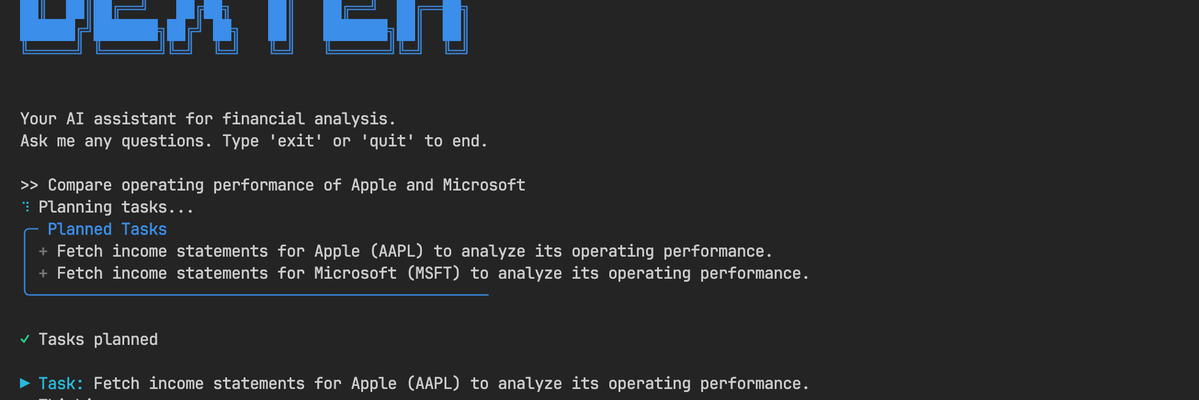
Dexter

Dexter is an autonomous financial research agent that transforms complex market questions into structured, data-driven analyses. It plans research steps, retrieves real-time financial data, validates its findings, and refines results automatically. Built for analysts, investors, and researchers, Dexter acts like a professional research assistant that learns, reasons, and delivers accurate insights without manual coding or data wrangling.
Dexter Details
Overview of Dexter
Dexter is an open source autonomous financial research agent designed to investigate companies, analyze financial performance, and answer complex market questions. Instead of producing a quick response from general model knowledge, Dexter creates a research plan, gathers relevant financial data, performs calculations, and reviews its own findings before presenting an answer.
The platform is built for users who need more than a basic company summary. Dexter can examine financial statements, compare businesses, identify performance trends, and evaluate important metrics across multiple reporting periods. It provides a structured approach to research that can reduce the time required to collect and organize financial information manually.
Dexter is particularly useful for investors, analysts, researchers, and developers who want an AI agent capable of completing multiple research steps independently. Users can ask a question in natural language, and Dexter determines which information it needs, which tools it should use, and how the findings should be organized.
Because Dexter is open source, developers can inspect its architecture, modify its behavior, add new tools, and adapt the agent to specialized financial workflows. This makes it both a practical research assistant and a flexible foundation for building custom financial intelligence applications.
What Is Dexter
Dexter is an autonomous AI agent created specifically for financial research. It transforms broad or complicated financial questions into smaller research tasks that can be completed and verified individually.
For example, a user may ask Dexter to compare the profitability of two public companies. Dexter can determine that it needs revenue, operating income, net income, and margin data for the selected period. It can then retrieve the information, calculate the relevant ratios, compare the results, and explain what the numbers may indicate.
This process differs from a standard chatbot interaction. A general chatbot normally attempts to answer a question immediately based on the information available in its context. Dexter follows an agent based process that includes planning, tool use, data retrieval, calculation, reflection, and answer refinement.
Dexter can work with current company and market data through connected financial data providers. This allows the agent to research income statements, balance sheets, cash flow statements, valuation metrics, growth rates, and other company fundamentals.
The agent also includes self validation capabilities. After completing a research task, Dexter reviews the information it collected and checks whether the answer is complete, consistent, and supported by the available data. When the result does not meet its requirements, it can revise the research plan or perform additional steps.
Dexter is intended to assist with research rather than replace professional financial judgment. Its outputs can help users organize information, uncover patterns, and prepare questions for further investigation. Investment decisions should still consider personal circumstances, risk tolerance, and qualified professional guidance.
How To Use Dexter
1. Review the Requirements
Before installing Dexter, review the project documentation and confirm that your computer has the required development tools. Dexter is designed for users who are comfortable running an open source application and configuring external services.
You may need access to a supported language model provider and a compatible financial data provider. These services allow Dexter to reason through research questions and retrieve the company information required for its analysis.
2. Download the Project
Visit the official Dexter repository and download or clone the project to your computer. Store the project in a location where you can easily access its files and configuration settings.
Developers can also create a separate fork of the repository. A fork is useful when you plan to modify Dexter, add private integrations, or maintain your own customized version.
3. Install the Dependencies
Open the project directory and install the required dependencies using the instructions included in the repository documentation. This prepares the local environment and installs the packages Dexter needs to run.
Check the installation output for missing packages or compatibility problems. Resolving these issues before adding your credentials can make the remaining setup process easier.
4. Add Your API Credentials
Create the required environment configuration file and add the credentials for your selected language model and financial data services.
Keep these credentials private. They should not be published in a public repository, shared in screenshots, or included in files that other users can access.
Your external providers may charge for model usage, financial data requests, or both. Review their pricing and usage limits before running large research projects.
5. Start Dexter
Run Dexter using the command provided in the project documentation. Once the agent starts, you can enter a financial research question through the available interface.
Begin with a clear and focused question. Include the company, ticker, financial metric, and time period whenever possible. Specific instructions help Dexter create a more relevant research plan.
6. Ask a Financial Question
Dexter can answer questions about company growth, profitability, cash flow, financial health, operating efficiency, and comparative performance.
Example questions include:
- How has Apple revenue changed during the last four reported quarters?
- Compare Microsoft and Alphabet operating margins over the previous fiscal year.
- What are the main drivers of Nvidia revenue growth?
- Has a selected company improved its free cash flow over the last three years?
- Compare the debt levels and liquidity positions of two competing companies.
Users can also ask follow up questions when they want Dexter to explain a calculation, investigate an unusual change, or examine another reporting period.
7. Review the Research Process
Dexter breaks the request into individual tasks before producing the final response. Depending on the question, these tasks may include collecting financial statements, calculating growth rates, comparing reporting periods, or checking the consistency of the results.
Review the research steps to understand how Dexter reached its conclusion. This is especially important when the analysis involves several assumptions, calculations, or data sources.
8. Verify Important Figures
Although Dexter includes self validation, users should independently confirm important figures before relying on them for financial decisions, published research, client work, or regulatory reporting.
Compare key numbers with company filings, investor relations materials, or another trusted financial database. Verification can help identify differences in reporting periods, accounting definitions, currency values, and adjusted metrics.
9. Refine Your Question
When the first answer is too broad, refine the request by adding more detail. You can specify a date range, financial statement, calculation method, competitor group, or desired output format.
For example, instead of asking whether a company is growing, ask Dexter to compare annual revenue growth, operating margin, and free cash flow during the last three fiscal years.
Clear research instructions generally lead to more focused analysis and reduce the number of assumptions the agent must make.
Customize Dexter
Dexter can be customized by changing its configuration, research limits, model providers, data tools, prompts, and agent behavior. This flexibility allows developers to adapt the project for different investment strategies, research standards, and technical environments.
Users can adjust how many research steps Dexter is permitted to complete during a task. A lower limit may reduce usage costs and response time, while a higher limit may allow the agent to investigate complicated questions more thoroughly.
The selected language model can also influence reasoning quality, speed, and operating cost. Developers may configure different models for planning, analysis, validation, or answer generation when supported by the project.
Additional financial data providers can be connected by extending Dexter’s tool system. A custom integration could provide access to market prices, company filings, earnings transcripts, economic indicators, industry data, or private business information.
Developers can also change the instructions that guide Dexter’s research process. These instructions may define how the agent evaluates evidence, presents uncertainty, calculates financial metrics, or separates factual findings from interpretation.
Organizations using Dexter internally can add specific reporting formats, approved data sources, review requirements, and risk controls. These customizations can help the agent follow existing research procedures instead of producing a generic response.
Any customized version should be tested carefully. Changes to prompts, tools, or task limits can affect the accuracy and consistency of the final analysis.
Dexter Key Features
Autonomous Research Planning
Dexter converts complex financial questions into organized research plans. It identifies the information required, separates the work into manageable tasks, and determines the order in which those tasks should be completed.
This allows users to request deeper analysis without manually describing every research step.
Financial Data Retrieval
The agent connects with financial data services to retrieve company fundamentals and market information. Depending on the configured provider, Dexter can access income statements, balance sheets, cash flow statements, and related company metrics.
Current data access makes Dexter more useful for financial research than systems that rely entirely on previously learned model knowledge.
Multi Step Analysis
Dexter can complete several connected tasks during a single research session. It may retrieve data, calculate ratios, compare reporting periods, evaluate trends, and combine the findings into one structured answer.
This workflow is valuable for questions that cannot be answered accurately with a single data lookup.
Self Validation
Dexter reviews its own findings before finalizing a response. The validation process helps the agent identify missing information, inconsistent calculations, or conclusions that require additional support.
When necessary, Dexter can continue researching or revise part of the analysis.
Company Comparison
Users can ask Dexter to compare companies using financial metrics such as revenue growth, gross margin, operating margin, free cash flow, debt, liquidity, and valuation.
The agent can organize the results into a clear explanation that highlights important similarities and differences.
Financial Trend Analysis
Dexter can analyze how a company’s performance changes across quarters or fiscal years. This can help users identify acceleration, slowing growth, margin expansion, declining cash generation, or changes in financial risk.
Trend analysis can provide more context than reviewing one reporting period in isolation.
Natural Language Questions
Users can describe their research needs using normal language. Dexter handles the planning and tool selection required to investigate the request.
This makes complex financial data more accessible to users who do not want to write database queries or manually combine information from multiple statements.
Configurable Research Controls
Developers can adjust research depth, step limits, model settings, and other controls. These options help balance analysis quality, speed, reliability, and external service costs.
Research controls can also prevent the agent from continuing unnecessary loops or using more resources than expected.
Open Source Architecture
Dexter’s source code is available for users to inspect, modify, and extend. Developers can study how the agent plans tasks, calls tools, validates findings, and produces answers.
The open source structure also allows teams to create private deployments or specialized versions for their own workflows.
Extensible Tool System
Dexter can be expanded with additional tools and data connections. Developers may add support for new financial databases, document sources, communication channels, reporting systems, or internal company platforms.
This extensibility allows Dexter to evolve beyond its default research capabilities.
Dexter Use Cases
Company Fundamental Analysis
Investors can use Dexter to examine a company’s revenue, profitability, expenses, cash flow, debt, and financial position. The agent can combine multiple metrics to provide a broader view of company performance.
Competitor Comparisons
Dexter can compare companies operating in the same market. Users can evaluate which business is growing faster, producing stronger margins, generating more cash, or maintaining a healthier balance sheet.
Earnings Preparation
Analysts can use Dexter before an earnings release to review recent performance, historical trends, and important financial questions. After results are published, the agent can help compare the new figures with previous periods.
Revenue Growth Research
Users can ask Dexter to calculate quarterly or annual revenue growth and identify changes in the growth rate. This can help reveal whether business momentum is improving, remaining stable, or slowing.
Margin Analysis
Dexter can examine gross margin, operating margin, and net margin over time. It can also compare margins across competitors or investigate the possible financial factors behind a major change.
Cash Flow Evaluation
The agent can review operating cash flow, capital expenditures, and free cash flow. This is useful for understanding whether reported earnings are translating into cash and whether the company has sufficient resources to support operations.
Financial Health Reviews
Dexter can help evaluate liquidity, debt, working capital, and other indicators of financial stability. Users can ask the agent to identify areas that may deserve additional investigation.
Investment Research Support
Investors can use Dexter as an initial research assistant when exploring a company or industry. The agent can collect information, calculate metrics, and organize findings before the user performs a final independent review.
Academic and Market Research
Students and researchers can use Dexter to explore financial relationships, compare company performance, and study changes across reporting periods. Its structured process can help users understand how a conclusion was developed.
Fintech Application Development
Developers can use Dexter’s open source architecture as a starting point for financial research applications. The project can be extended with new interfaces, specialized tools, private datasets, and custom reporting workflows.
Recurring Financial Reports
Teams can adapt Dexter to generate recurring company comparisons, financial summaries, or metric reviews. Automating the initial analysis can reduce repetitive manual research.
Research Workflow Testing
AI developers can study Dexter to understand autonomous task planning, tool use, reflection, and validation. The project provides a practical example of how agent based systems can complete specialized research tasks.
Dexter FAQ
Is Dexter Open Source?
Yes. Dexter is available as an open source project. Users can review the code, run the agent in their own environment, create a fork, and modify its functionality.
Always review the repository’s current license and documentation before using the code in a commercial application.
Is Dexter Free?
The Dexter software can be downloaded and used as an open source project. However, users may still pay for language model requests, financial data access, hosting, storage, or other external services connected to the agent.
The total cost depends on the selected providers and how frequently Dexter is used.
What Does Dexter Analyze?
Dexter is designed to analyze financial and company data. It can research revenue, expenses, profitability, margins, cash flow, debt, growth rates, and other business performance metrics.
Its available information depends on the financial data provider connected to the project.
Does Dexter Provide Real Time Financial Data?
Dexter can retrieve current financial and market information through connected data services. The exact update frequency depends on the provider, subscription plan, market, and type of information requested.
Some company fundamentals may update after official financial reports are released rather than continuously.
Does Dexter Make Investment Decisions?
Dexter can organize financial information and produce research based conclusions, but it should not be treated as a licensed financial adviser or a guaranteed investment decision system.
Users remain responsible for verifying the information and making their own decisions.
How Is Dexter Different From a Standard AI Chatbot?
A standard chatbot usually responds directly to a prompt. Dexter can create a research plan, call financial data tools, complete calculations, validate its work, and revise the analysis before delivering the final answer.
This process makes Dexter better suited to complex financial questions that require multiple steps.
Can Dexter Compare Multiple Companies?
Yes. Dexter can compare public companies using available financial metrics and reporting periods. Clear instructions about the companies, time range, and metrics will usually produce a more focused comparison.
Can Dexter Analyze Private Companies?
Dexter’s default capabilities focus on information available through its connected financial data providers. Private company analysis may require users to add internal documents, custom databases, or another compatible data source.
Does Dexter Require Technical Knowledge?
Installing and configuring the open source project may require familiarity with development tools, environment files, API credentials, and command line interfaces.
Once configured, users can interact with Dexter through natural language questions.
Can Dexter Be Used by a Team?
Yes. Teams can adapt Dexter for shared research workflows, recurring reports, internal tools, or financial applications. Additional development may be required to manage access, collaboration, storage, and security.
Can Developers Add New Data Sources?
Yes. Developers can extend Dexter by creating integrations with additional financial databases, document repositories, market feeds, or internal systems.
The quality of the final output will depend partly on the reliability and structure of the connected data.
Does Dexter Validate Its Answers?
Dexter includes a self validation process that reviews research findings and determines whether additional work is needed. This can improve completeness and consistency, but it does not eliminate every possible error.
Important results should always be checked against reliable primary information.
Can Dexter Generate Financial Reports?
Dexter can organize its findings into structured research responses. Developers may also customize the project to produce specific report formats or connect it with document generation tools.
The available export options depend on the version and interface being used.
Is Financial Data Sent to External Services?
Dexter may send prompts, research context, and tool requests to configured external providers. Users should review the privacy terms of every model and data service they connect.
Organizations working with confidential information should carefully evaluate how data is stored, transmitted, and processed.
Who Should Use Dexter?
Dexter is best suited to investors, financial analysts, researchers, students, fintech developers, and technical users who want an autonomous assistant for structured financial research.
It may be less suitable for users who want a completely managed platform that requires no installation or configuration.
What Are Dexter’s Main Limitations?
Dexter depends on the quality of its connected data, the reasoning capabilities of the selected model, and the clarity of the user’s request. It may misunderstand ambiguous instructions, use inconsistent financial definitions, or produce an incomplete interpretation.
Users should provide specific questions, review the research process, and independently confirm important conclusions.
Explore More AI Agents
Discover other AI agents and tools to enhance your workflow and productivity.
Browse All AgentsRelated AI Agents
View All Agents →
Tale
Tale is an open-source project workspace for teams and AI agents. Teammates plan tasks on a shared board, assign work to people or agents, and review the results together, while agents run in persistent sandboxes using runtimes such as Claude Code and Codex. It combines task boards, shared knowledge, workflows, and governance controls, and can be self-hosted with Docker or run as managed Cloud. Tale is MIT licensed, and the free Community edition includes every feature.

VoiceDrop
VoiceDrop is a ringless voicemail and SMS platform built for sales teams. It clones a user’s voice from roughly a 30-second sample and delivers personalized voicemails to US mobile and VoIP numbers without ringing the phone, with two-way SMS in the same workflow. Billing applies only to successful deliveries, and the platform includes SOC 2 Type II compliance, Do Not Call suppression, phone validation, a REST API, and Zapier and Make integrations.

Arvow
Arvow is an AI SEO platform for marketers and agencies. Its agents help research, write, and publish content in a brand’s voice, identify technical SEO issues, and find relevant sites for contextual backlinks. Arvow also tracks brand mentions across AI search tools, bringing content, site optimization, link building, and AI visibility into one platform.
Trending AI Agents
View All Agents →
Site Speak
SiteSpeak AI lets you train a custom chatbot on your website content, FAQs, and documents. Site Speak AI can answer visitor questions instantly, 24/7, with no coding required.

Murf AI
Murf AI is a text-to-speech platform that transforms written content into lifelike voiceovers. It’s perfect for creators, educators, and businesses needing high quality narration without recording audio manually.
Synthesia
Synthesia is an AI video generation platform that lets users create professional-looking videos using realistic AI avatars. It enables anyone to turn text into engaging videos in minutes—no cameras, microphones, or actors required.
Tale
Tale is an open-source project workspace for teams and AI agents. Teammates plan tasks on a shared board, assign work to people or agents, and review the results together, while agents run in persistent sandboxes using runtimes such as Claude Code and Codex. It combines task boards, shared knowledge, workflows, and governance controls, and can be self-hosted with Docker or run as managed Cloud. Tale is MIT licensed, and the free Community edition includes every feature.
VoiceDrop
VoiceDrop is a ringless voicemail and SMS platform built for sales teams. It clones a user’s voice from roughly a 30-second sample and delivers personalized voicemails to US mobile and VoIP numbers without ringing the phone, with two-way SMS in the same workflow. Billing applies only to successful deliveries, and the platform includes SOC 2 Type II compliance, Do Not Call suppression, phone validation, a REST API, and Zapier and Make integrations.
Arvow
Arvow is an AI SEO platform for marketers and agencies. Its agents help research, write, and publish content in a brand’s voice, identify technical SEO issues, and find relevant sites for contextual backlinks. Arvow also tracks brand mentions across AI search tools, bringing content, site optimization, link building, and AI visibility into one platform.